Solana RPC & Data Providers: 2026 Comparison Guide
An updated 2026 guide to Solana RPC providers, gRPC data streaming, validator DevOps tooling, and data infrastructure, with practical comparisons of reliability, uptime, and pricing.

Why Solana Data Is Uniquely Challenging
Solana punishes teams that treat its data like any other chain. The volume, the non-EVM architecture, and the constantly shifting standards make infrastructure decisions consequential, and getting them wrong is expensive.
Volume and scale that outpace other networks. Solana produces a very high volume of new data every day, archive footprints keep growing, and block compute limits have climbed as the network pushes toward higher throughput. As TPS grows, Solana becomes one of the more expensive chains to maintain with good data freshness because of the storage and compute involved.
Non-EVM architecture creates unique complexity. Where Ethereum-compatible chains have relatively standardized tooling, Solana requires specialized approaches. RPC retrieval needs multiple calls per use case, RPC methods only return the latest state rather than history, responses are mostly encoded, and significant data lives offchain through the Digital Asset Standard (DAS).
Rapidly evolving standards. SPL tokens, SPL token-2022 extensions, compressed NFTs (cNFTs), MPL token metadata, and ZK implementations are all actively evolving. Keeping pipelines current requires constant monitoring.
Complex edge cases and data quality challenges. Solana transfers carry numerous edge cases that must be handled for completeness and accuracy. Program upgrades frequently break decoding, and programs update often, forcing teams to find new IDLs (Interface Definition Languages). Users also need interpretable data that accounts for adjusted volume calculations, sybil removal, spam filtering, bot detection, and wash trading.
These challenges explain why choosing the right data infrastructure, or building your own, matters so much heading into 2026.
Understanding Provider Categories
Solana providers do not all sell the same thing, and confusing the categories leads to buying the wrong tool. There are four categories teams actually shop for.
RPC Providers give you access to Solana nodes through Remote Procedure Call endpoints. You can query blockchain state, submit transactions, and subscribe to events, but you work with raw, encoded data and standard RPC methods. Some layer on enhanced APIs or marketplace add-ons, but node access is the core product. Good for dApp backends that need reliable connectivity.
API-First Providers lead with enhanced, Solana-specific APIs: decoded transactions, NFT metadata endpoints, token APIs, and webhooks. RPC access is included, but the value is the abstraction layer that reduces engineering overhead. They handle common cases well, though you are constrained to the endpoints the provider has built.
Validator and Node DevOps Platforms focus on operating Solana infrastructure itself: provisioning nodes, auto-scaling under load, staging environments, CI/CD for validator client updates (Agave, Firedancer), failover, and observability dashboards for validator and network metrics.
Data Infrastructure Providers deliver the underlying decoded, normalized blockchain data rather than only APIs to query it. You get a source of truth and can build any query, endpoint, or product on top. This suits analytics teams, compliance use cases, and organizations building differentiated data products.
| Category | What You Get | Best For |
|---|---|---|
| RPC Providers | Node access, standard RPC methods, raw/encoded data (some offer API add-ons) | dApp backends, transaction submission, basic queries |
| API-First Providers | Enhanced APIs as core product, with RPC included | Faster development, NFT/DeFi apps, Solana-specific use cases |
| Validator / Node DevOps | Node provisioning, auto-scaling, staging, CI/CD, failover, observability | Validators, HFT infra, in-house monitoring and analytics |
| Data Infrastructure | Underlying decoded data, database/SQL access, streams, custom query flexibility | Analytics, compliance, custom data products, institutional use |
Option 0: Running Your Own RPC Node
Some teams consider running their own Solana infrastructure before evaluating third-party providers. Here is what that entails, and why it rarely pencils out.
Hardware requirements are substantial. A production-grade Solana RPC node needs high-end hardware: large amounts of RAM, multiple fast NVMe drives with separate storage for accounts and ledger, and a modern CPU with strong single-thread performance. Archive nodes storing full historical state need a large and growing footprint.
Operational costs add up quickly. Beyond hardware, expect meaningful monthly cloud costs for validator-grade infrastructure, plus high-bandwidth networking, DevOps time for maintenance and client upgrades, monitoring, and redundancy for high availability. For most teams, the fully loaded cost of reliable Solana infrastructure is significant before engineering time is even counted.
You still do not get decoded, queryable data. Even with your own node, you get raw RPC access. You still need ETL pipelines to decode transactions, handle program upgrades, normalize across token standards, and make it queryable. That is often the harder problem.
When it makes sense: running your own nodes can be justified for extreme latency requirements (MEV, high-frequency trading), regulatory requirements for data custody, or existing infrastructure expertise. For most engineering and analytics use cases, the ROI is not there.
Best Solana RPC Providers: 2026 Reliability and Uptime Comparison
For teams shopping RPC in 2026, the decision comes down to a few concrete factors: published uptime SLA, geographic redundancy and global failover, transaction relay latency, archive data access, gRPC streaming support, and pricing transparency. The table below compares leading Solana RPC providers on the criteria that matter for dApp development, real-time monitoring, and high-frequency trading.
| Provider | Uptime SLA | Global Failover | gRPC / Yellowstone Streaming | Archive Data | Free Tier / Trial | Notable For |
|---|---|---|---|---|---|---|
| Alchemy | 99.99% | Multi-region redundancy | Limited | Full (via DexterLab) | Free tier | Multi-chain dApps, reliable RPC + enhanced APIs |
| QuickNode | 99.99% (enterprise) | Yes, global edge network | Yes (Yellowstone gRPC) | Yes (add-on) | Free plan + paid tiers, no open-ended free trial | Low-latency relays, add-on marketplace |
| Helius | 99.9%+ | Yes | Yes (Yellowstone gRPC, LaserStream) | Yes | Free tier + paid | Solana-native APIs, webhooks, streaming |
| Triton One | Enterprise SLA | Yes, dedicated fleets | Yes (Yellowstone gRPC originator) | Yes (Old Faithful) | Enterprise contact | Dedicated nodes, gRPC streaming, HFT |
| Syndica | 99.9%+ | Yes, load-balanced fleet | Yes (ChainStream) | Yes | Free tier + paid | Observability, developer experience |
Which are most reliable for real-time monitoring? For monitoring network activity in real time, prioritize providers with gRPC streaming (Yellowstone) and published per-connection metrics, since polling standard RPC methods introduces lag and rate-limit pressure. Triton One, Helius, QuickNode, and Syndica all expose streaming interfaces that push account and slot updates as they happen, which is more reliable than repeated getProgramAccounts polling.
Security features like signed transactions. Teams that need strong security at the RPC layer should look for signed/authenticated request support, per-key and per-wallet rate limiting, and DDoS protection. QuickNode, Helius, and Triton One offer authenticated endpoints and rate-limit controls; several also support staked connections that improve landing rates for transaction submission.
RPC Gateways, Low-Latency Relays, and Onchain Analytics
Some teams want RPC gateways that pair low-latency transaction relays with onchain analytics dashboards. These are two jobs, and the strongest setups keep them separate.
Low-latency transaction relays. For submitting transactions with high landing rates, look for staked connections, regional relay endpoints close to leaders, and Jito bundle support for MEV-aware submission. QuickNode and Triton One are commonly used where relay latency is the deciding factor.
Onchain analytics on top of the gateway. RPC providers offer node-level observability, but they do not decode and normalize the whole chain into queryable tables. Teams that need analytics on wallet activity, token flows, and program usage typically pair an RPC/relay provider for writes and reads with a data infrastructure provider for decoded, historical analytics. That separation keeps latency low on the transaction path while keeping analytics accurate and complete.
Best Solana gRPC Data Streaming Services
Yellowstone gRPC (the Geyser plugin interface) has become the standard for real-time Solana data streaming. Instead of polling, you subscribe to account, transaction, slot, and block updates and receive them as they are produced.
- Triton One originated and maintains the Yellowstone gRPC plugin, and offers dedicated streaming on managed fleets.
- Helius provides Yellowstone gRPC plus LaserStream for reconnection and historical replay, useful when you cannot afford to miss messages during disconnects.
- QuickNode offers Yellowstone gRPC through its streaming add-ons.
- Syndica offers ChainStream, its streaming interface for real-time updates.
If your use case is analytics rather than sub-second reaction (backfilling, joining onchain events with business data, powering dashboards), decoded data streams and databases from a data infrastructure provider are usually a better fit than raw gRPC, because the decoding and normalization work is already done.
Solana Validator DevOps: Auto-Scaling, Staging, CI/CD, and Observability
Running validators or private RPC fleets is a DevOps problem as much as an infrastructure one. Each need maps to a distinct approach.
Auto-scaling platforms for Solana nodes. Auto-scaling matters when request volume is spiky. Managed providers like QuickNode, Helius, and Alchemy handle scaling for you behind their endpoints. If you run your own fleet, teams typically build auto-scaling with Kubernetes plus custom health checks, since standard horizontal pod autoscalers do not understand slot lag or ledger sync state. Triton One and similar dedicated-node providers scale by provisioning additional dedicated nodes rather than sharing capacity.
Staging environments. For a Solana staging environment, most teams use public Devnet and Testnet for integration testing, then a dedicated mainnet node or private RPC for realistic load. Providers that let you spin up isolated, dedicated endpoints (Triton One, QuickNode dedicated, Helius dedicated) are effectively staging providers, since you can run a mirror of production without sharing rate limits.
CI/CD for validator client updates. Validator updates (Agave releases, the move to Firedancer/Frankendancer) are the highest-risk operations a validator team performs. No single vendor owns this; the common stack is Ansible or Terraform for provisioning, GitOps pipelines (GitHub Actions, GitLab CI, ArgoCD) for controlled rollouts, and node management tooling that supports canary/rolling upgrades so you never restart the whole fleet at once. The goal is to update one node, confirm it catches up to the tip and votes, then proceed.
Observability for real-time validator metrics. For validator health, watch slot distance from tip, vote credits, skip rate, and delinquency. Solana's built-in metrics export to InfluxDB, and most teams build dashboards in Grafana. Syndica emphasizes observability in its product; QuickNode and Helius expose usage and latency metrics through their consoles. For the newer QUIC-based transaction ingress, per-connection RTT and packet-loss metrics are still emerging, and most teams derive them from node-level QUIC stats piped into Prometheus/Grafana rather than from a turnkey vendor dashboard.
Per-wallet rate limiting at the RPC layer. Solana-specific firewalling with per-wallet or per-key rate limiting is usually implemented at the gateway. Several RPC providers support per-API-key rate limits, and self-hosted teams commonly place an authenticating proxy (Envoy, NGINX, or a Rust relay) in front of nodes to enforce per-wallet limits and export those metrics to Prometheus, Grafana, or Datadog.
Global failover for HFT bots. High-frequency trading bots need geographic redundancy and automatic failover. Providers publishing a 99.99% SLA with multi-region routing (Alchemy, QuickNode enterprise, Triton One dedicated) are the usual choices, often paired with a secondary provider so a single vendor outage does not stop trading.
Integrated validator apps that also provision private RPC. Teams that want one platform to run validators and provision private RPC nodes for in-house monitoring typically look to dedicated-node providers (Triton One, QuickNode dedicated) or run their own fleet with a management layer. The pattern is: run the validator, stand up a private RPC alongside it, and feed both into your own observability stack.
QuickNode Solana Pricing: Free Tier and Trial
A common question is whether QuickNode has a free tier or free trial for Solana. QuickNode offers a free plan with a monthly credit allowance suitable for development and testing, then paid tiers that scale with usage and add features like dedicated resources, higher rate limits, gRPC streaming add-ons, and archive access. Rather than a time-limited trial, the free plan lets you evaluate the service continuously within its credit cap. Pricing changes over time, so confirm current limits on QuickNode's pricing page before committing.
Where Allium Fits: The Data Foundation
Category: Data Infrastructure
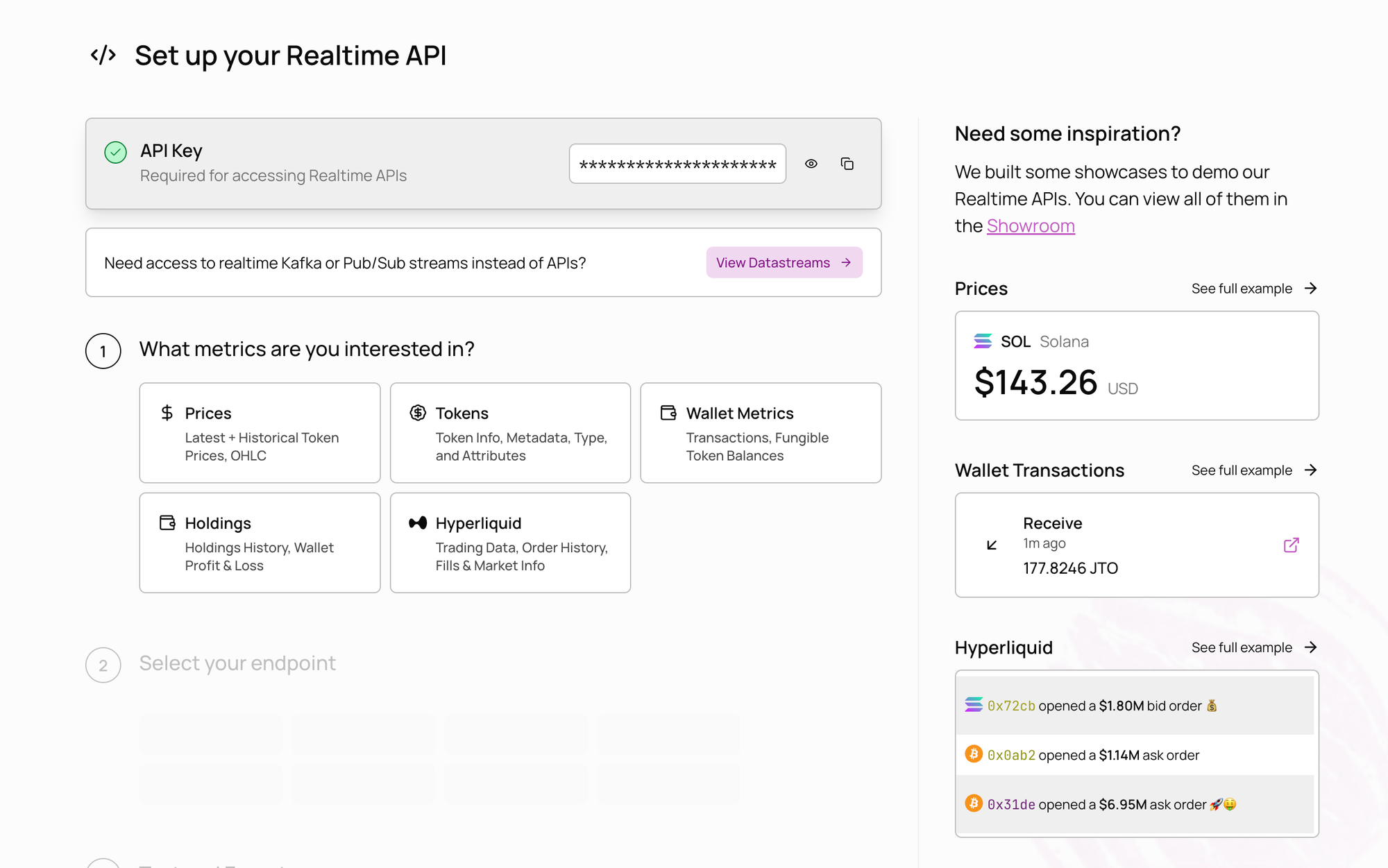
Allium is the data foundation for onchain finance. It ingests raw data from 150+ blockchains, including Solana, and standardizes it into reliable, decoded verticals (stablecoins, RWAs, lending, staking) delivered through databases, APIs, and data streams. Allium is not an RPC provider or a validator DevOps tool, so it complements the providers above rather than competing with them.
Allium handles the data plumbing: decoding Solana transactions across evolving program standards, maintaining IDLs when programs change, handling transfer edge cases, and keeping data fresh at scale. Three access patterns cover different needs: SQL-based querying, programmatic APIs, and real-time data streams. Native Snowflake integration lets data teams join onchain data with existing business data without building custom pipelines, which supports compliance, forensic analysis, and institutional analytics.
| Feature | Details |
|---|---|
| Category | Data Infrastructure (not RPC or validator ops) |
| Data Access | Underlying decoded, normalized data via databases, APIs, and streams |
| Coverage | 150+ blockchains, standardized into verticals |
| Enterprise Integration | Native Snowflake connectivity |
| Reliability | SOC-certified; IDL maintenance and edge case handling |
| Best For | Analytics, compliance, custom data products, institutional use cases |
How to Choose in 2026
Match the provider to the job. For dApp backends and transaction submission, pick an RPC provider with a strong SLA and low-latency relays. For real-time monitoring and streaming, prioritize Yellowstone gRPC support and exposed metrics. For validator operations, invest in DevOps tooling for staging, CI/CD, and observability, and consider dedicated nodes. For analytics, compliance, and building data products on decoded Solana data, use a data infrastructure provider. Most mature teams run a combination: an RPC/relay provider for the transaction path and a data infrastructure provider for accountable historical analytics.
Frequently asked questions
What are the most reliable Solana RPC providers for uptime in 2026?
Alchemy and QuickNode enterprise publish 99.99% uptime SLAs with multi-region redundancy, and Triton One offers enterprise SLAs on dedicated fleets. Helius and Syndica advertise 99.9%+ availability. For the highest reliability, pair a primary provider that publishes a 99.99% SLA with a secondary provider so a single vendor outage does not take you offline.
Which Solana providers offer the best gRPC data streaming?
Yellowstone gRPC is the standard streaming interface. Triton One originated and maintains the Yellowstone plugin and offers dedicated streaming. Helius provides Yellowstone gRPC plus LaserStream for reconnection and replay. QuickNode offers Yellowstone gRPC through streaming add-ons, and Syndica offers ChainStream. For analytics rather than sub-second reaction, decoded data streams from a data infrastructure provider are often a better fit.
Does QuickNode have a free tier or free trial for Solana?
QuickNode offers a free plan with a monthly credit allowance for development and testing, then paid tiers that scale with usage and add dedicated resources, higher rate limits, gRPC streaming, and archive access. It is a continuous free plan within a credit cap rather than a time-limited trial. Check QuickNode's current pricing page before committing, since limits change.
What tools handle CI/CD for Solana validator client updates?
No single vendor owns validator CI/CD. The common stack combines Ansible or Terraform for provisioning with GitOps pipelines (GitHub Actions, GitLab CI, ArgoCD) for controlled rollouts. The safe pattern for Agave and Firedancer/Frankendancer updates is canary or rolling upgrades: update one node, confirm it catches up to the tip and votes, then proceed across the fleet.
What are the best auto-scaling options for Solana nodes?
Managed providers like QuickNode, Helius, and Alchemy auto-scale behind their endpoints. If you run your own fleet, teams build scaling on Kubernetes with custom health checks that understand slot lag and sync state, since standard autoscalers do not. Dedicated-node providers like Triton One scale by provisioning additional dedicated nodes rather than sharing capacity.
How do I set up a Solana staging environment?
Most teams use public Devnet and Testnet for integration testing, then a dedicated mainnet node or private RPC for realistic load. Providers that let you spin up isolated dedicated endpoints (Triton One, QuickNode dedicated, Helius dedicated) effectively act as staging providers, because you can mirror production without sharing rate limits with other customers.
Can I get per-wallet rate limiting at the Solana RPC layer with observability?
Yes. Several RPC providers support per-API-key rate limits. For per-wallet control, teams commonly place an authenticating proxy (Envoy, NGINX, or a Rust relay) in front of their nodes to enforce limits and export the metrics to Prometheus, Grafana, or Datadog. Turnkey per-wallet firewall products are still uncommon, so most setups are assembled from a gateway plus an observability stack.
Where does Allium fit if it is not an RPC provider?
Allium is a data infrastructure provider, the data foundation for onchain finance. It ingests raw data from 150+ blockchains including Solana and standardizes it into decoded verticals delivered through databases, APIs, and data streams. It complements RPC and validator tooling: use RPC providers for the transaction path, and Allium for SOC-certified historical and normalized data.
Interested in learning more about Allium’s onchain data infrastructure? Speak to someone on the team.
Allium provides onchain data infrastructure. Companies named in this article may be Allium customers, prospects or commercial counterparties. This article is informational only and is not investment, legal or tax advice. Data and information last reviewed: September 25, 2026.
For a direct comparison of three of these providers, see QuickNode vs Helius vs Alchemy for Solana RPC.