Base Chain: Why 81% of Its Dollars Are USDC
Base is Coinbase's Ethereum layer 2, built on the OP Stack. 81% of its $5.35B in stablecoins is USDC, against 21% across all chains, and its organic transfers average under $300.

Base is an Ethereum layer 2 network built by Coinbase on the open-source OP Stack: it executes transactions off Ethereum's main chain and posts the data back to Ethereum for security. According to Allium's dataset, Base holds $5.35B of free-floating stablecoins, and 81% of it is USDC, against 21% for USDC across all chains (Allium data, November 3, 2026).
Key takeaways
- Base launched in 2023 on the OP Stack. Users pay gas in ETH, and Coinbase operates the sequencer that orders transactions.
- USDC is $4.33B of Base's $5.35B in stablecoins. USDT, the largest stablecoin overall, is $27.0M there.
- Organic stablecoin volume on Base was $3.99B across 12.8 million transfers in 30 days. USDC transfers averaged $294, a consumer-scale ticket.
- Raw transfer volume on Base was $2,723.6B over the same period, which shows how much non-organic activity raw counts include.
How Base works
- A user signs a transaction on Base and pays a fee in ETH.
- The sequencer orders transactions into Base blocks, which confirm in about two seconds.
- Batches of transaction data are posted to Ethereum, so anyone can reconstruct Base's state from Ethereum.
- Withdrawals back to Ethereum through the native bridge wait through a challenge window, during which an invalid state can be disputed. That takes days. Third-party bridges offer faster exits for a fee.
The design trades some decentralization, with one company running the sequencer, for low fees and fast confirmation, with Ethereum as the place disputes are settled. Full detail is in the Base documentation.
Why Base runs on USDC
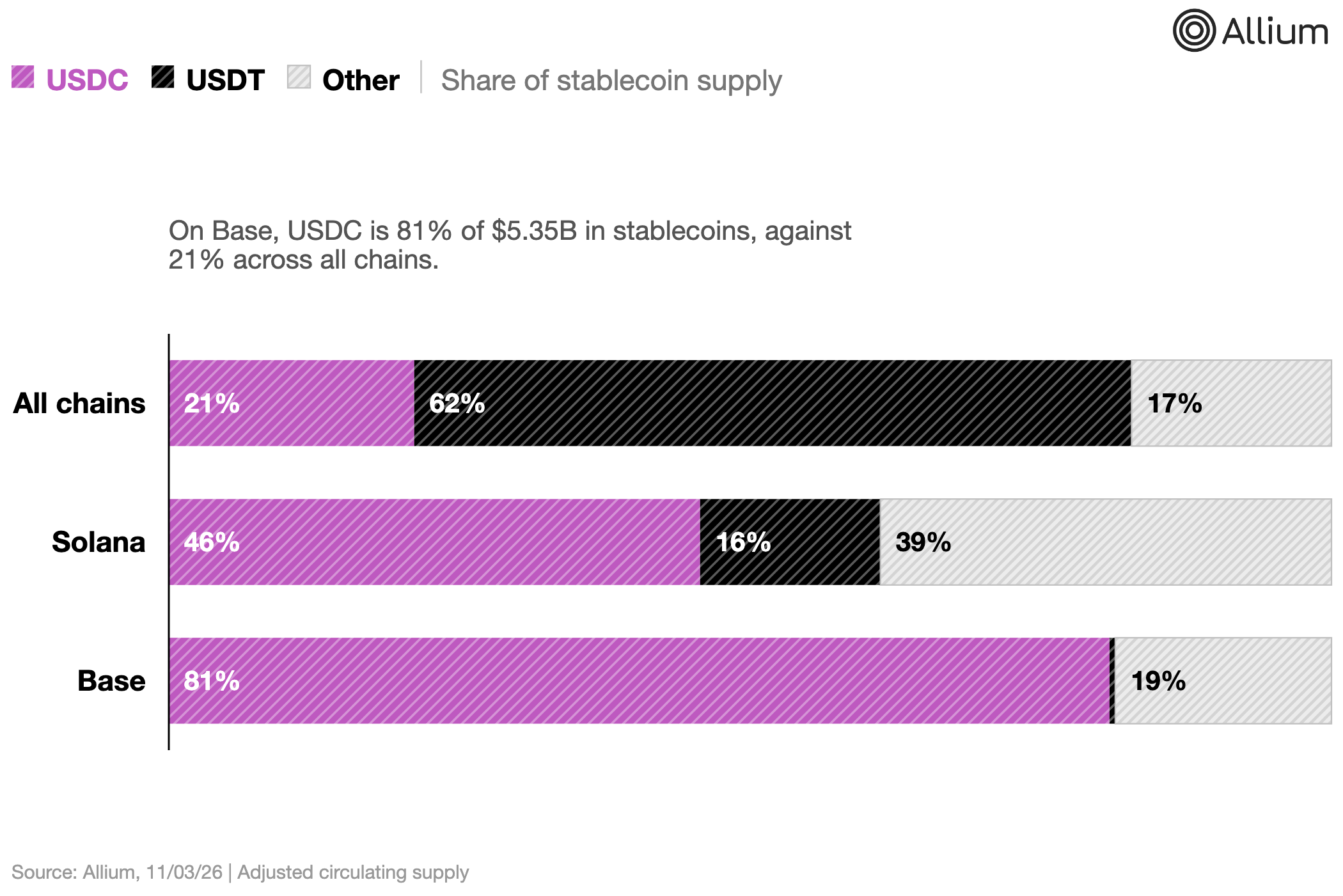
Base's stablecoin economy is close to a single-token economy, and the reasons are structural. Coinbase and Circle have a long commercial relationship around USDC, Base is reachable directly from Coinbase's own apps, and USDC is the dollar most Base apps default to. USDT has barely been deployed there natively. Solana, by comparison, is USDC-led but far more mixed.
| Stablecoin on Base | Adjusted supply | Share | Organic volume, 30 days | Avg organic transfer |
|---|---|---|---|---|
| USDC | $4.33B | 81% | $3.70B | $294 |
| USDe | $395.7M | 7.4% | not shown | not shown |
| EURC | $55.7M | 1.0% | $109.3M | $1,983 |
| USDT | $27.0M | 0.5% | $60.1M | $592 |
| All stablecoins | $5.35B | $3.99B |
Allium data. Supply as of November 3, 2026; adjusted (organic) volume Oct 4 to Nov 2, 2026. Base ranks fifth by stablecoin supply after Ethereum, Tron, Solana and BSC.
The average USDC transfer on Base, $294, is in line with Solana ($305) and a fraction of Ethereum's ($6,834). Base is where small, frequent dollar payments happen, not where large balances move. Tokenized assets follow the same pattern of modest size: about $308M across 48 products, led by private credit ($129.2M) and rates products ($104.9M), including the Franklin OnChain U.S. Government Money Fund ($60.0M).
How the Base figures are measured
Allium's adjusted circulating supply starts from total supply and removes issuer reserves, bridge escrows, protocol collateral, savings vaults and frozen addresses. It is Allium's estimate of the supply that is actually free-floating, and it is the figure used throughout this article. On a layer 2 the bridge escrow exclusion matters most: dollars that arrived through a bridge are counted once, on Base, while the originals locked on Ethereum are removed.
Volume needs the same treatment. Raw transfer counts on Base are dominated by non-organic activity, which is why $2,723.6B of raw volume becomes $3.99B once Allium's adjusted volume filters out non-organic transfers. Every record resolves to the same fields, issuer, contract, native or bridged status and USD value, across 150+ chains in Allium's stablecoin datasets. For how other teams read Base activity, see making sense of onchain data at Base.
Frequently asked questions
Who runs the Base chain?
Base was built and is operated by Coinbase, which runs its sequencer. The network settles to Ethereum and is built on the open-source OP Stack.
What token pays gas on Base?
Gas on Base is paid in ETH.
How much stablecoin supply is on Base?
Allium's data shows $5.35B of free-floating stablecoins on November 3, 2026, with USDC at $4.33B, about 81%.
Why is there so little USDT on Base?
USDT has barely been deployed natively on Base, while USDC is the default dollar across Coinbase's apps and most Base apps. Allium shows $27.0M of USDT there.
Why do withdrawals from Base take days?
The native bridge waits through a challenge window so invalid state can be disputed on Ethereum. Third-party bridges offer faster exits for a fee.
Compare chains on the same data. Browse chain-level coverage across 150+ chains, or read What Is Onchain Data Normalization? for how the records are put together.
Building something that needs this data? Talk to the team.
Allium provides onchain data infrastructure. Companies named in this article may be Allium customers, prospects or commercial counterparties. The authors and other Allium personnel may hold positions in the assets discussed. This article is informational only and is not investment, legal or tax advice. Data and information last reviewed: November 4, 2026.