How BCG built the stablecoin payments data foundation anchoring its digital assets practice


Max Zevin, Managing Director and Partner in BCG's Payments and Fintech practice, on building a stablecoin segmentation methodology from scratch — and what it shows the world's largest financial institutions about where the market is heading.
BCG's Payments and Fintech practice works with clients across the full spectrum of financial services: the world's largest global banks, payment networks, issuers, and fintechs. As stablecoins moved from a crypto-native phenomenon to something their clients needed a position on, BCG faced the same challenge every institution did: clear market data didn't exist.
Blockchain transactions are technically public — but the raw volume figures in circulation mixed trading, algorithmic transfers, and bridging activity with genuine economic activity. Nobody had agreed on a methodology to separate them.
"Blockchain data — it's like looking through many panes of glass. It's very transparent, but only in certain ways."
Max Zevin is a Managing Director and Partner in BCG's digital assets practice. For BCG to advise its clients with conviction — and to build the thought leadership that underpins that work — it needed a data foundation.
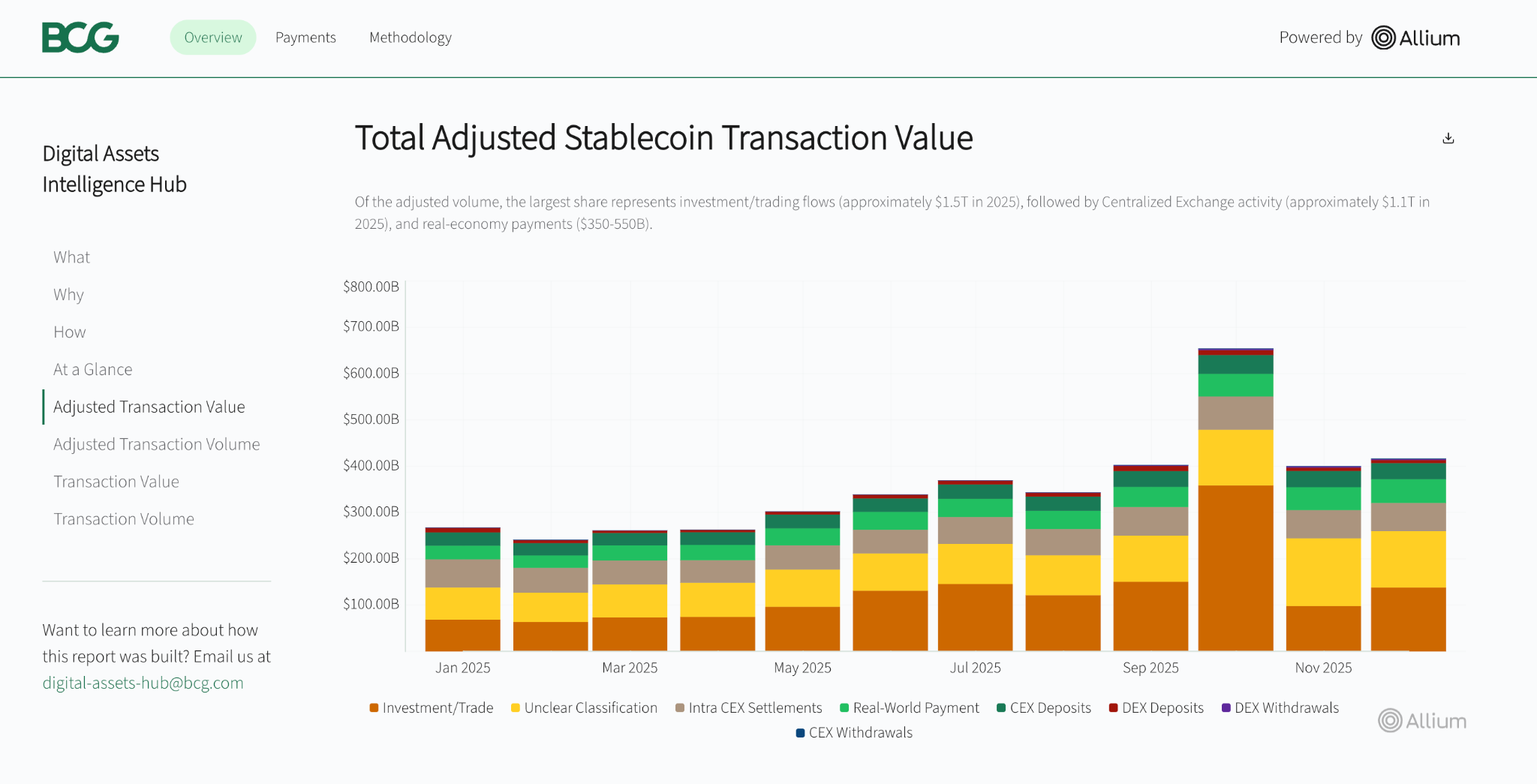
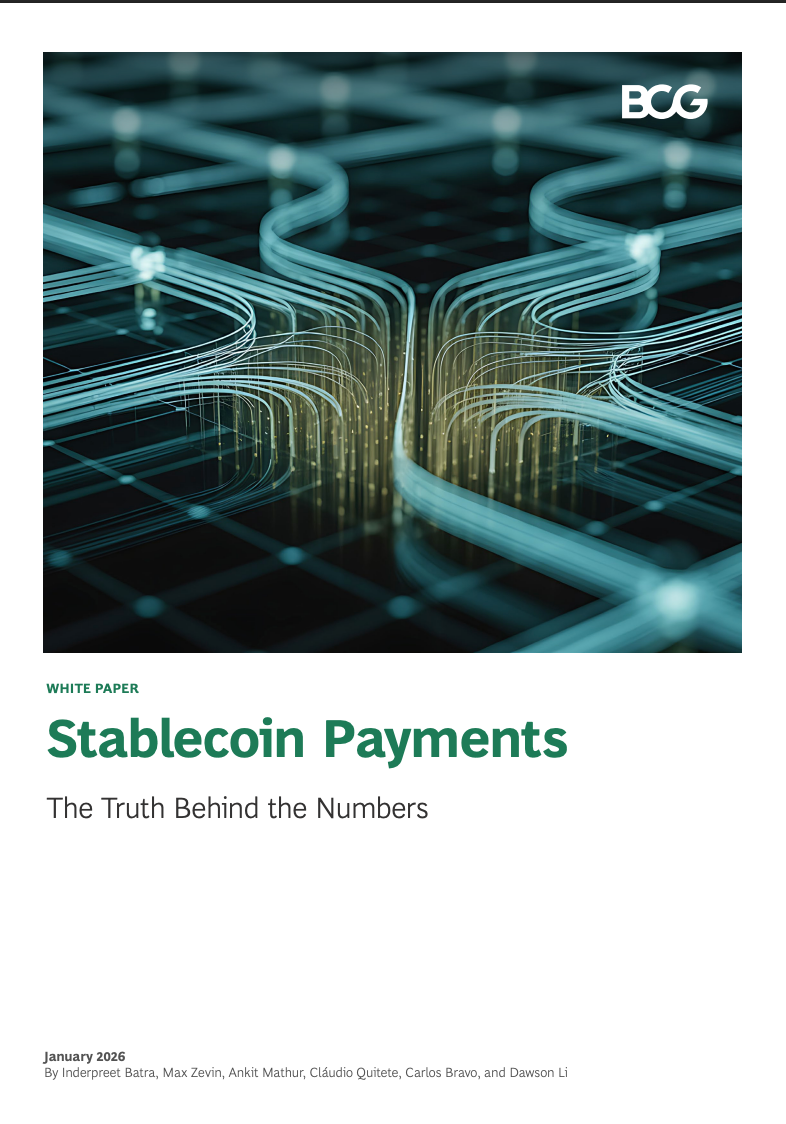
Working with Allium, Max and his team filtered $62 trillion in gross stablecoin volume (annual, 2025) down to real economic activity, segmented by use case (B2B, B2C, C2C, etc.). The result is BCG's stablecoin payments dashboard and its research report, Stablecoin Payments: Truth Behind the Numbers, now core assets in BCG's digital assets advisory practice and used directly in client engagements with some of the world's largest financial institutions.
Stablecoin data is transparent. Payment activity is not.
The growth of digital assets has moved faster than most financial institutions' ability to evaluate it. New use cases emerge weekly. The competitive dynamics keep shifting.
For BCG's clients, from the biggest global banks to regional fintechs, the most common questions are:
"What's the implication of the growth of digital assets for my business and why? Where can we take advantage? Where are the defensive plays? How do we execute?"
Stablecoin transactions are public on the blockchain. But the raw data doesn't distinguish a fund rebalancing its position from a business paying a supplier in another country. Without that distinction, the volume figures don't tell a bank what it needs to know.
Getting from $176 trillion to analyses that support thought leadership
In traditional payments, transaction volume by use case and vertical is well-documented. BCG can quantify consumer-to-business retail commerce down to the vertical level because there's decades of data infrastructure behind it.
For stablecoins, none of that segmentation existed.
"Everybody talks about all these big numbers. And everyone says a bunch of it is used for trading, a bunch of it is tied to algorithms. But what we really wanted to get down to is brass tacks — how are people and businesses using stablecoins today, where and why?"
BCG considered two options: 1) aggregate data across industry participants, or 2) build from a single cohesive dataset. The scattershot approach produces the kind of research that's easy to poke holes in, so BCG chose the other path.
What made Allium the right foundation wasn't just breadth of coverage, but the depth of work Allium had already done on top of the raw data: decoded, classified, and made interpretable before BCG's team ever touched it.
"Our choice was to take a single cohesive dataset — which, frankly, Allium provides the best one out there because you already do a lot on top of that data to actually make it interpretable — abstracting the layers and making it useful."
Building the payments classification methodology with Allium
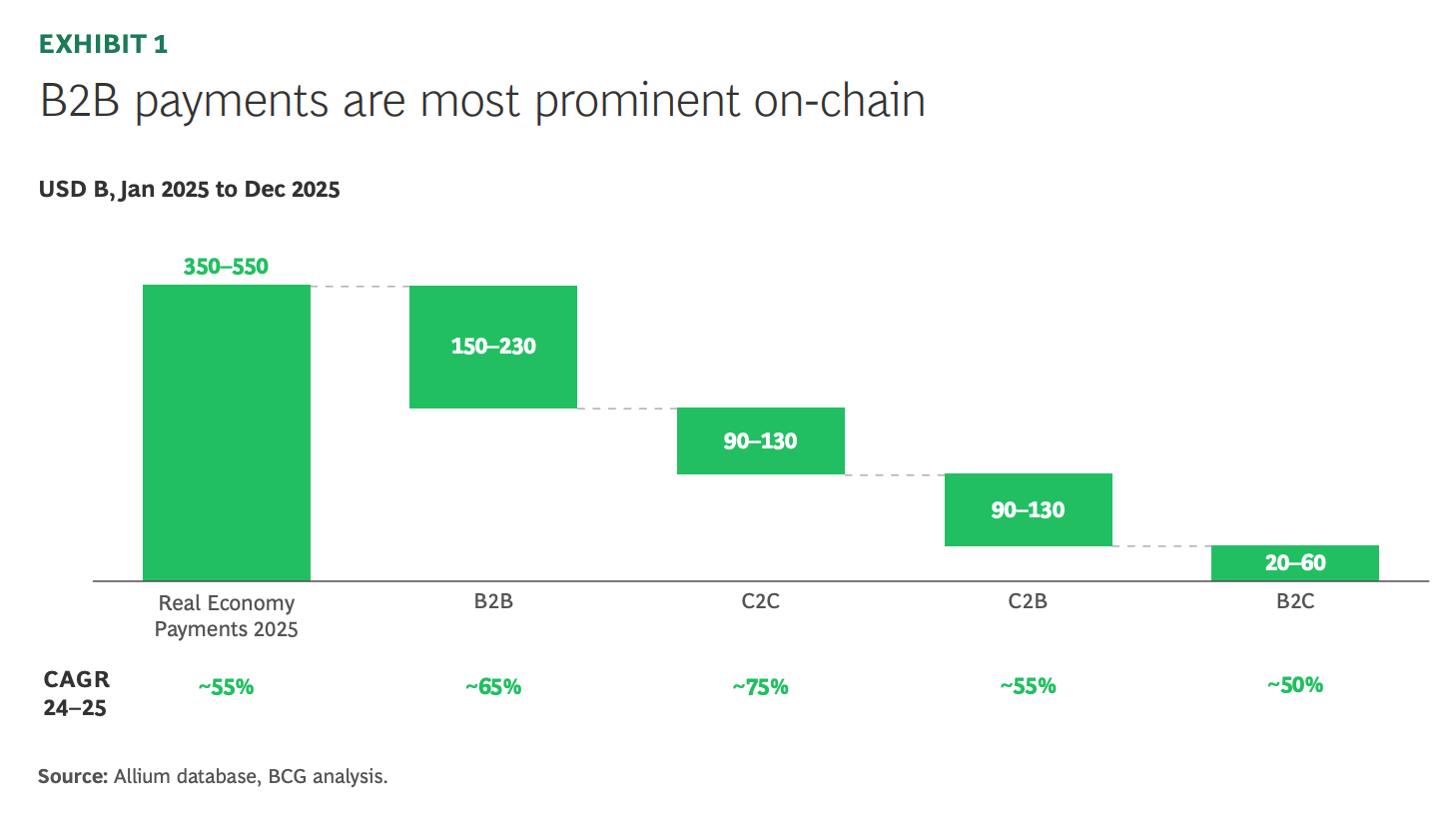
BCG and Allium built the classification algorithm together, filtering out bots, protocol-level transfers, internal exchange movements, and multi-hop transactions — bringing $62 trillion in gross volume down to $350–$550 billion in real-world payments, less than 1% of the initial gross figure.
Further segmentation defined clear splits across B2B, C2C, and B2C payments. B2B is the dominant category by value at roughly 40%, driven primarily by cross-border flows. C2C — mostly remittances — is the fastest-growing at 75% year-over-year. B2C remains the smallest category.
While BCG kept its analytical work in-house, Allium served as an onchain specialist on the data side — a thought and execution partner from data engineering to methodology definition.
"The partnership with Allium was much more than providing the data. It was weekly, daily engagement to brainstorm the methodology, test different cuts, and refine the algorithm — to get from trillions down to a couple hundred billion of what we later called real-world payments."
What Allium enables for BCG
BCG's stablecoin payments dashboard now sits at the center of its digital assets advisory practice — used to shape internal strategy, drive industry thought leadership, and advise some of the world's largest financial institutions.
It gives BCG data infrastructure that goes beyond headline projections, with visibility into what stablecoins are being used for, at what volumes, and across which geographies.
"It's generated a lot of client traction, both in our active engagements and in client discussions and industry engagement. It's now a foundational piece of our digital assets practice infrastructure."
The dashboard also underpins BCG's published research — including Stablecoin Payments: Truth Behind the Numbers. BCG's next phase intends to go deeper: corridor-level analysis, expanded use case breakdowns, and eventually a data product.
"We want to put out a revised version of the dashboard and the dataset that gives industry participants even deeper access into cross-border payments, in partnership with Allium.”
3 future value drivers for onchain finance
As part of BCG and Allium's ongoing research work, Ethan Chan, co-founder and CEO of Allium, and Inderpreet Batra, Senior Partner at BCG leading the global payments and fintech practice, shared where they see financial institutions focusing in a recent conversation:
The near-term disruption is in cross-border B2B. That's where stablecoins solve real friction: 24/7 settlement, no correspondent banking delays, direct USD liquidity in corridors where moving money is slow and expensive. Domestic retail payments in carded markets like the U.S. are largely protected by existing infrastructure — the economics of rewards, consumer protections, and instant settlement don't favor a switch.
The broader consumer case is playing out first in high-inflation emerging markets, where demand for dollar-denominated savings is high. A flywheel is forming: cross-border inflows arrive in stablecoins, merchants begin accepting them, domestic consumer use follows.
The third value driver — programmable payments tied to smart contracts — hasn't shown up meaningfully in the data yet. When it does, it changes the competitive dynamics across a much wider range of transactions.
BCG and Allium are continuing to build deeper insights in partnership — corridor-level analysis, expanded use case breakdowns, and a data product in the pipeline that would give industry participants direct access to the intelligence.
Max Zevin is a Managing Director and Partner at BCG. Learn more about BCG’s digital assets practice.
Building research infrastructure or data methodology for digital assets? Contact us →