How Ondo's First Data Scientist Turns Onchain Activity into Market Intelligence


Alex Chen, first data scientist at Ondo Finance, on running a data function for one of the fastest-growing tokenized asset protocols — and why he buys his data infrastructure instead of building it.
Ondo Finance is a leading tokenized RWA issuer with over $2B in onchain market value across its two flagship products, Ondo U.S. Dollar Yield (USDY) and the Ondo Short-Term U.S. Government Bond Fund (OUSG), both giving holders onchain exposure to U.S. Treasuries and money market yield. Ondo Global Markets, its tokenized stocks platform, has also surpassed $1B in total value locked, a first for the tokenized equities category.
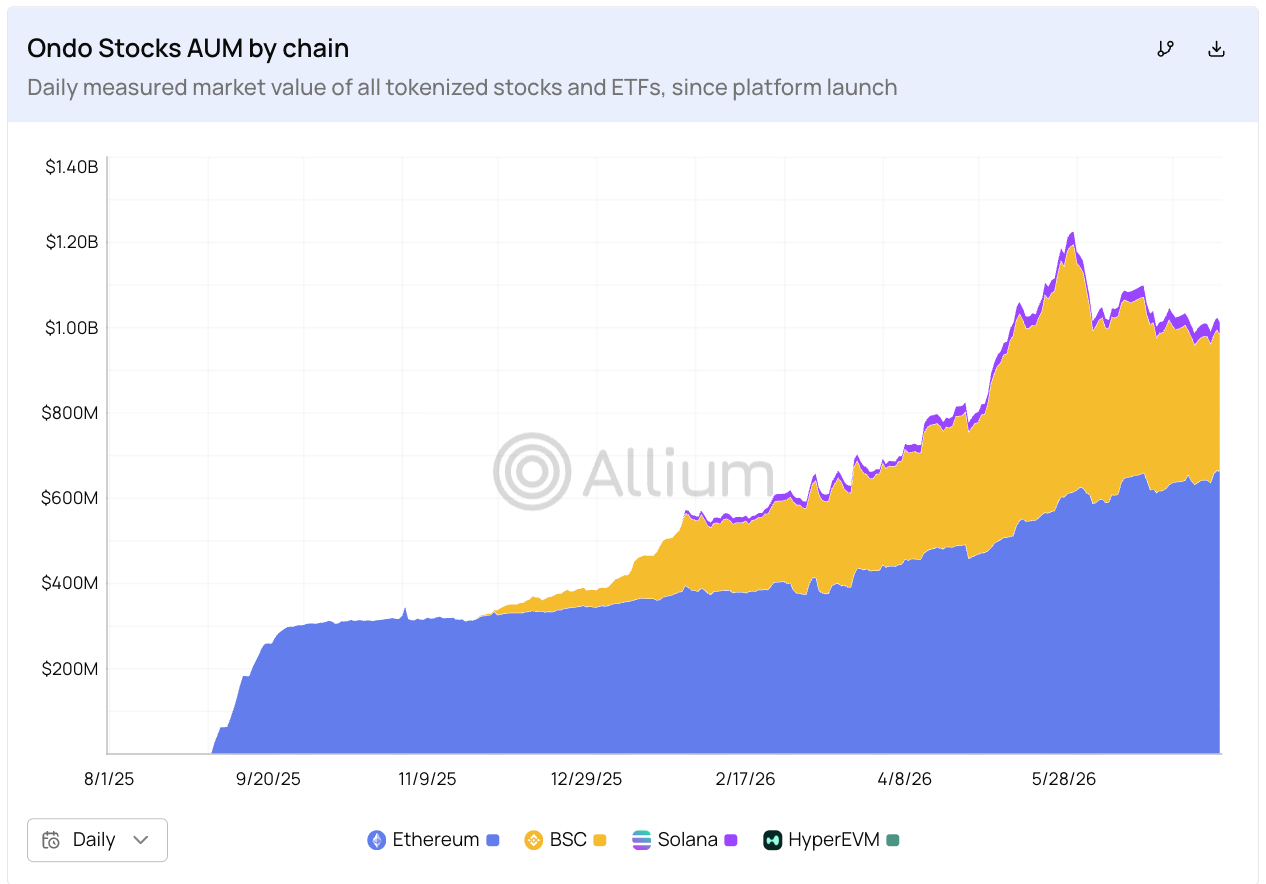
That value doesn't sit in one place. It's spread across eight active chains — Ethereum holds the majority at 56%, but nearly half lives elsewhere: Stellar at 23%, Sei at 11%, Solana at 8%, and the rest across others. Understanding Ondo's own market means reasoning across all of them at once, on one consistent view.
A business at that scale runs on a surprisingly lean data function. Alex Chen is Ondo's first data scientist, serving the business, marketing, and engineering teams. At his prior organization, a stablecoin issuer, building data infrastructure meant starting from raw blockchain data and writing every pipeline from scratch. At Ondo, he built the function differently: on top of Allium, so one person can produce actionable market intelligence instead of maintaining blockchain plumbing.
Being a solo data scientist means serving everyone
Being Ondo's first data scientist sounds like a clean mandate, but what it means in practice is there's no infrastructure to inherit and every team is already waiting on answers.
"I'm the first data person, so I respond to a lot of different internal partners — the marketing team, the engineering team, for business team. They all need different types of insights."
The business team wants market intelligence: TVL, volume, growth rates, whether customers react to price.
Marketing wants campaigns tied to onchain outcomes.
Engineering wants behavioral patterns: which takers for tokenized stock are gaining traction, which map to the biggest categories.
Every team asks something different, but the foundation starts from the same place: clean, trustworthy data on what's happening onchain.
The core problem in blockchain analytics
Blockchain data is permissionless by design. Anyone can deploy a contract with any schema. The result is a dataset that's transparent in principle and chaotic in practice: formats differ across protocols, events need decoding contract by contract, and nothing is standardized across chains.
For a data scientist trying to produce business insights, that forces a decision before any real work starts: build and maintain the data infrastructure yourself, or find a reliable data layer that has already done it.
Alex has done it both ways. At his prior company, the stablecoin issuer Circle, the team built everything from raw blockchain data.
"When I was at Circle, we had to build all the blockchain data scripts from raw data. Back then we didn't have access to mature data vendors to provide clean blockchain data."
Mature data vendors exist now, so the first data hire at a company like Ondo faces a different call than Alex did a few years ago: build the infrastructure, or spend that time on the insights only they can produce. At Ondo, he chose the second.
"Aggregating blockchain data is the hard work. I'd rather have clean data infrastructure to build insights faster on top of that."
How Ondo works with Allium
Ondo runs its analytics on Allium's decoded, standardized data. Rather than writing and maintaining pipelines per chain and per protocol, Alex queries transactions, balances, and cross-protocol activity that arrive already cleaned and structured for comparison. When Ondo needs a view its competitors can't easily assemble — the full tokenized asset market on one consistent schema — Allium is where that lives.
"Allium did a super good job aggregating all tokenized assets and also having a good schema that we use for comparisons, such as competitor volume vs. Ondo volume, so we can generate business insights based on that."
What Allium enables for Ondo
A data scientist who ships insights, not pipelines. Blockchain data scientists have historically spent most of their time cleaning data and a fraction generating insight. Working on decoded transactions and standardized schemas flips that ratio: Alex queries the data directly instead of building toward it.
"Think about the leverage. For most data scientists, 80% of your time is spent cleaning data and only 20% is using the clen data to generate insights. You can do it yourself, but think about the time you need to spend to make the data usable for insights. I'd rather leave the 80% work to the professional team who does it, and use that leverage."
Competitive benchmarking across the whole tokenized asset market. Ondo needs to know exactly how it stacks up against other issuers on TVL, volume, and growth. Because Allium aggregates tokenized assets on one consistent schema, that comparison is a query, not an entire data engineering project.
A clear read on who your users actually are. Blockchain addresses carry no location by design, but geography drives product and go-to-market decisions. Allium's data supports timezone analysis, wallet behavior patterns, and protocol affiliation — enough to build a credible estimate of where demand is coming from.
"Every business owner wants to know who their users are. In the blockchain world that's harder, but we can still get an estimate. For tokenized stocks, are the users in Asia, in Singapore, in the EU? Answering that tells us who to target as our main user group."
How to build a data science function in digital assets
Alex is now a two-time onchain data scientist — once building blockchain insights from raw data at Circle, once with leverage from existing Allium infrastructure at Ondo.
Two things have made the mechanical part of the job easier in the past year: 1) data infrastructure matured, and 2) AI changed how fast code gets written. Both help data scientists do the same thing — spend less time writing code, more time deciding what's worth knowing.
"I didn't believe the quality of code would be where it is even four or five months ago. But right now I already have tools that have taken over parts of my job. I'm not writing a lot of code manually right now, but I'm still producing a lot of code. I'm thinking about how to generate insights first."
The industry has moved from decoding raw data to bridging traditional finance and blockchain — corporate actions, dividends, onchain liquidity translated into terms a traditional finance team recognizes. The insight part got harder, especially as the scope keeps growing, and data scientists now have the bandwith to dig deeper to uncover actionable data.
"When I work as a data scientist with onchain data, sometimes I label myself as an 'onchain police.' Sometimes you find a super weird thing and you don't understand why, but if you go deeper — because every log, every transaction is there — you find an answer."
Alex's practical advice for a lean data science team: don't build the data layer yourself. Decoding and standardizing chain data is constant, unglamorous engineering. If you're the only data scientist, or one of a few, spend that time on the analysis that drives business value.
Learn more about Ondo Finance. Connect with Alex on LinkedIn.
Building data infrastructure or analytics for tokenized assets and don't want to clean the data yourself? Contact us →