MiCA's Next Challenge: Turning Regulatory Clarity Into Market Visibility
Before recalibrating a threshold, check how the metric is computed. Allium's September 2026 response to the European Commission's targeted consultation on the review of MiCA, and what independent onchain data can and cannot tell a supervisor.


In September 2026, Allium submitted a response to the European Commission's targeted consultation on the review of MiCA. Our contribution focused on a fundamental challenge for regulators: how to measure and monitor markets that operate across jurisdictions, blockchains and intermediaries.
As MiCA moves from regulatory design to implementation, the quality of the data used to assess market activity becomes increasingly important.
MiCA's implementation so far has been a significant step forward for regulatory clarity and market development in the EU. The growing number of authorised entities and the level of international interest suggest it is becoming a reference point for crypto-asset regulation well beyond Europe. Several of the questions the review now asks are questions about numbers, and a number is only as good as the method that produced it.
Three points from our response are worth restating here.
How a metric is computed comes before where the threshold sits
MiCA classifies an e-money token or asset-referenced token as significant against numerical thresholds. The review asks whether those thresholds are calibrated correctly.
Our position is that we would not necessarily recommend recalibrating the numbers before considering how the underlying metrics are calculated. Raw onchain data can materially overstate or mischaracterise economic activity. Transfers between wallets controlled by the same entity, automated trading, protocol mechanics and intermediary routing all post to the ledger alongside genuine payments.
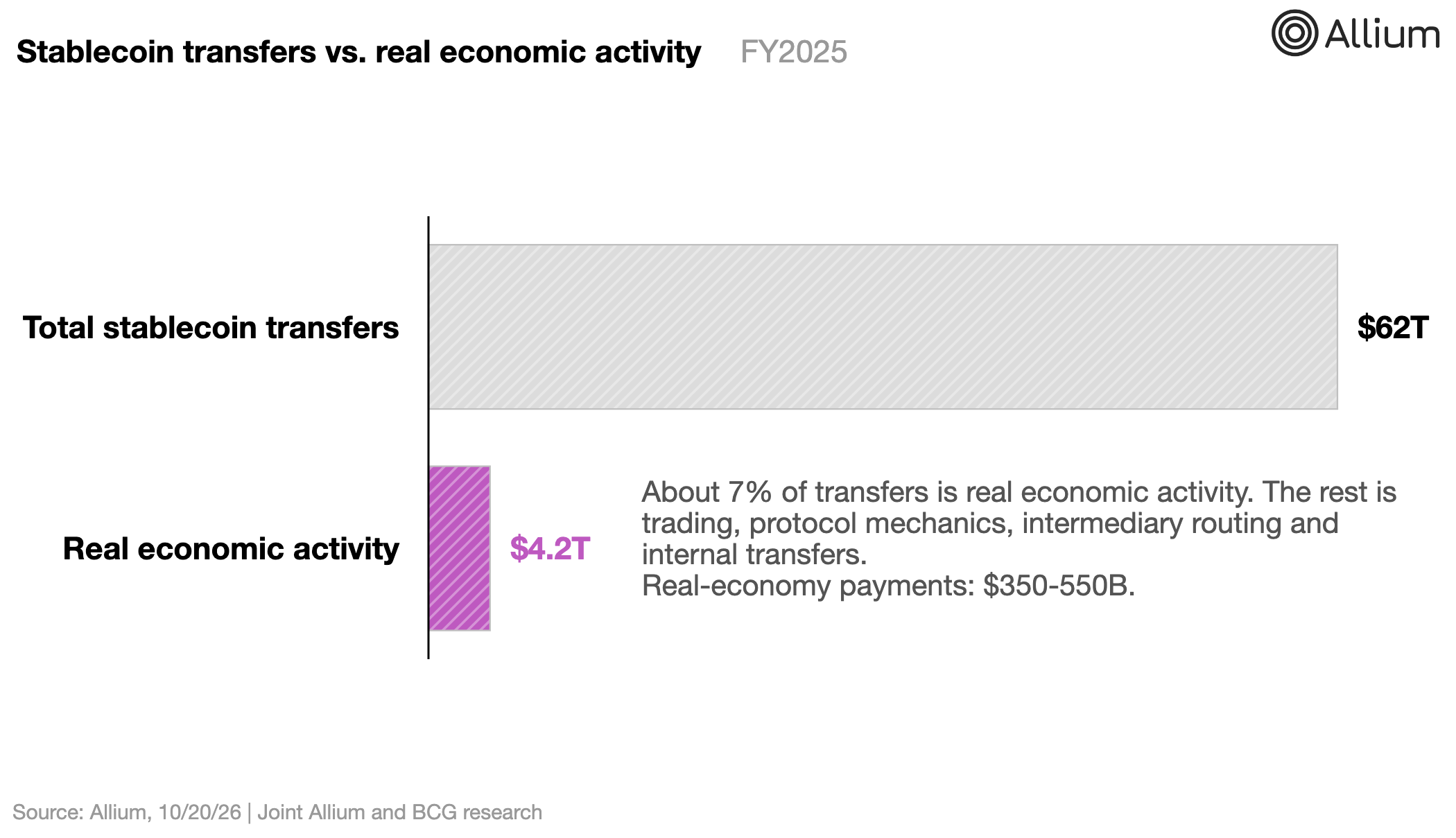
The scale of that gap is public. In joint research with Boston Consulting Group, we separated total annual stablecoin transfers into activity identifiable as economic and activity likely to be bots, protocol mechanics, internal transfers and intermediary routing. The joint Allium and BCG Digital Assets Intelligence Hub, read on 20 October 2026, puts FY2025 stablecoin transfers at more than $62 trillion, of which $4.2 trillion is real economic activity, about 7% of the total. Real-economy payments for goods and services account for $350bn to $550bn. On a transaction count, the same adjustment runs from roughly 16 billion to just under 2 billion. These figures illustrate why transparent methodologies matter. Different definitions of economic activity can produce dramatically different results, with direct implications for how regulatory thresholds are assessed. The method is also set out in Stablecoin Payments: The Truth Behind the Numbers, and we apply it in our quarterly stablecoin reporting.
So any recalibration could usefully come with a clear methodology for calculating the quantitative criteria, including independent data used to validate reported metrics. That gives supervisors consistency and gives issuers certainty about the basis on which they may be assessed as significant.
Alongside transaction volume and holder count, we suggested metrics that capture economic footprint and concentration more directly:
- Use classification. Distinguishing payments from trading, transfers between intermediaries, and protocol activity.
- Holder and liquidity concentration. How supply is distributed across exchanges, DeFi protocols, institutions and end users.
- Cross-border and geographic activity.
- Velocity and turnover.
- Cross-chain activity. Supply, volume and liquidity moving between blockchains.
These are increasingly measurable from onchain data, and they describe how an asset is used rather than only how often it moves.
EU holdings are determinable, provided the method says which parts are estimated
For the purposes of MiCA's reserve requirements, EU holdings can be estimated from onchain data. Our view is that EU-held tokens are sufficiently determinable, provided supervisory methodologies keep the distinction between directly attributable and estimated holdings.
The two sit at different confidence levels. CASP exposure can often be monitored through identifiable exchange and institutional wallets, including changes in their balances over time, though a balance at a venue tells you the venue's jurisdiction rather than the residency of every underlying customer. Self-custodied holdings require a different approach again: balances are directly observable, but geographic attribution is estimated from multiple indirect signals. These methods produce aggregate jurisdictional estimates for supervisory purposes. They are not used to identify or locate individual holders.
Stating that distinction is not a caveat bolted on at the end. It is what makes the figure usable. A supervisor should be able to see which part of a number was observed, which part was inferred and with what confidence, and which part still has to come from a regulated entity. We would say the same about our own numbers.
Markets that run continuously need evidence that does too
Traditional market infrastructure was built around trading hours, identifiable intermediaries and jurisdiction-specific reporting. Onchain markets keep none of those assumptions reliably, and tokenized assets can show materially different patterns of activity from their traditional counterparts.
One measured example: in our analysis of onchain real-world asset markets, tokenized equities were Solana's largest RWA asset class by spot volume, and 63% of that spot volume traded while US exchanges were closed, over the twelve months to 18 August 2026. We use Solana as the measurement case because its RWA activity is among the largest and best covered onchain. Activity is still densest during US hours; the finding is that a substantial tail sits outside them, where an hours-based reporting regime does not look. Details are in our Solana RWA analysis.
For European supervisors, this raises a practical question: how do you monitor market activity when trading continues across global venues and jurisdictions, regardless of traditional market hours?
The same gap applies to supervising crypto-asset service providers. ESMA has made clear that, following the end of the transitional period, unauthorised CASPs providing services to EU clients must cease those activities, but whether a service reaches EU customers is often not observable from a provider's corporate or regulatory footprint. Onchain data can add evidence by identifying flows between EU-linked wallets and entities outside the perimeter, and relationships between wallets, exchanges and other service providers. Combined with the ESMA register, that lets authorities see activity across venues on one consistent basis.
Where Allium fits
Reporting by issuers and regulated entities remains essential, and independent data does not replace it. Legal ownership, customer identity and offchain financial arrangements are not recorded on a blockchain. No dataset establishes compliance, and we are not a supervisory authority.
What we add is the observable side. Standardised onchain records covering stablecoin supply, payments, holder composition and transaction flows across chains, consistent enough that a reported metric can be checked against observable activity and a historical position can be reconstructed at a point in time. Our stablecoin datasets are documented publicly.
Our closing recommendation to the Commission was deliberately narrow. Rather than new reporting obligations, the Commission and national competent authorities could consider targeted pilots using independent onchain data against specific supervisory questions: stablecoin exposure, EU-held tokens, or validation of reported market activity. MiCA Article 23 is a useful example, since competent authorities may need to rely on their own estimates when assessing an asset-referenced token. Pilots would show which methodologies hold up and where independent data adds most, before anyone writes a requirement around them.
MiCA has established the regulatory framework. The next challenge is ensuring supervisors have the information needed to assess how markets operate within it.
Independent onchain data can help close that gap, provided the methodologies are transparent, reproducible and clear about what can and cannot be measured.
Related reading
- Allium Comments on FINRA's Proposal to Modernize Best Execution Guidance
- Allium Comments on the SEC's Proposal to Rescind Regulation NMS Rules 611 and 610(e)
- MiCA and Stablecoins: What the Rules Require
- Blockchain Analytics for Regulators: A Vendor Guide
About this post. Allium is an enterprise blockchain data company providing real-time and historical data across public blockchains to supervisory organisations, financial institutions and other sophisticated market participants. The European Commission does not publish individual responses to targeted consultations, so this post summarises ours rather than linking it.
Interests. Allium sells the kind of data this post argues is useful to supervisors. Allium also has commercial relationships with entities named in this post, including a research partnership with Boston Consulting Group.
Data. Figures attributed to the Stablecoin Payments Dashboard are the output of joint Allium and BCG research, read on 20 October 2026. The 63% tokenized equity figure is from Allium's Solana RWA analysis, covering the twelve months to 18 August 2026.
Not advice. Informational only. This post summarises a consultation response and is not legal, regulatory, compliance or investment advice. No dataset establishes compliance with MiCA or any other regime, and Allium is not a supervisory authority.