What Is USDG? Paxos's Global Dollar, Mostly Off Ethereum
USDG, the Global Dollar, is a dollar stablecoin issued by Paxos. It grew from almost nothing to $2.81B in two years, and 42% of it sits on X Layer rather than Ethereum.

USDG, the Global Dollar, is a dollar-backed stablecoin issued by Paxos and distributed through the Global Dollar Network, a group of exchanges, fintechs and payment firms that hold and distribute it. According to Allium's dataset, USDG has $2.81B of free-floating supply across seven chains, and the largest share, 42%, is on X Layer, the network run by the exchange OKX, while Ethereum holds 12% (Allium data, November 5, 2026).
USDG at a glance
| USDG | |
|---|---|
| Issuer | Paxos, through Paxos Digital Singapore (regulated by the Monetary Authority of Singapore) and Paxos Issuance Europe (regulated by Finland's Financial Supervisory Authority under MiCA) |
| Backing | One for one in US dollar deposits, short-term US government securities and other cash equivalents |
| Redemption | One for one into US dollars through Paxos, for onboarded customers |
| Networks tracked by Allium | Seven, led by X Layer, Robinhood Chain, Solana and Ethereum |
| Who earns the reserve income | Global Dollar Network partners, in proportion to the USDG they hold or distribute. Holders do not earn yield from Paxos. |
| Other Paxos dollar stablecoins | USDP (Pax Dollar) and PYUSD, which Paxos issues for PayPal |
Key takeaways
- USDG crossed $1M of supply in October 2024 and averaged $3.43B in August 2026, its peak month so far.
- Supply has since eased 17%, to a November average of $2.86B.
- X Layer ($1.19B), Robinhood Chain ($672M) and Solana ($491M) each hold more USDG than Ethereum ($338M).
- Arbitrum holds only $56.5M but moved $260.2M of organic volume in 30 days, 4.6 times its supply, the fastest turnover of any chain Allium measures for USDG.
How USDG works
USDG follows the fiat-backed model: Paxos holds reserves of cash and short-term US government instruments meant to back each token one for one, publishes attestations, and mints or redeems for onboarded customers. Paxos issues it through regulated entities in Singapore and the EU. What sets USDG apart is distribution. Members of the Global Dollar Network receive a share of the reserve income in proportion to the USDG they hold or help distribute, which gives exchanges and apps a reason to hold and push it to their users. That incentive is one likely reason for where the supply sits, although the onchain data shows where USDG is held, not why.
Where USDG lives
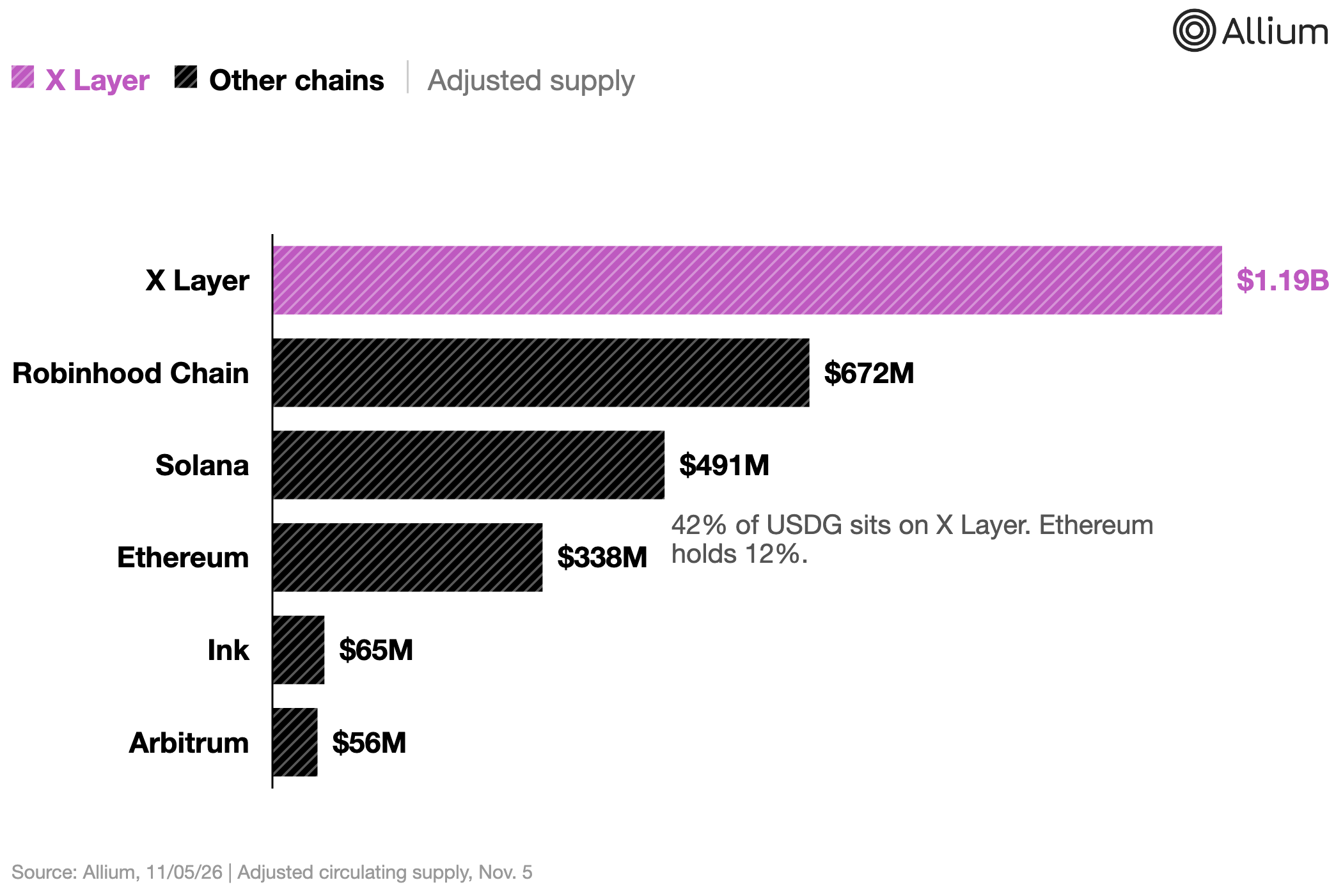
A stablecoin that launches on Ethereum usually keeps most of its supply there. USDG did not: its two largest chains are networks operated by trading platforms, X Layer and Robinhood Chain, which together hold 66% of supply. That is consistent with a stablecoin distributed through platform partners, with supply sitting where those partners' users are.
| Chain | Adjusted supply | Organic volume, 30 days | Organic transfers |
|---|---|---|---|
| X Layer | $1,188.7M | not measured | |
| Robinhood Chain | $672.1M | not measured | |
| Solana | $490.8M | $263.7M | 73.7K |
| Ethereum | $338.0M | $157.0M | 8.5K |
| Ink | $65.1M | $24.6M | 9.5K |
| Arbitrum | $56.5M | $260.2M | 14.2K |
Allium data. Supply as of November 5, 2026; adjusted (organic) volume Oct 5 to Nov 3, 2026. Organic volume is not yet measured on X Layer or Robinhood Chain.
Where volume is measured, the chains split by use. Solana's USDG moves in many mid-sized transfers, about $3,600 on average. Ethereum's moves in few large ones, about $18,500. Arbitrum's small balance turns over fastest, consistent with dollars used for trading rather than held.
How the USDG figures are measured
Allium's adjusted circulating supply starts from total supply and removes issuer reserves, bridge escrows, protocol collateral, savings vaults and frozen addresses, so it measures the supply that is actually free-floating. Organic volume uses Allium's adjusted volume method, which filters out transfers that do not reflect economic activity, such as contract-internal movements, liquidity routing and repeated hops of the same funds. The gap is large for USDG: raw transfer volume on Solana was $8.17B over the 30 days, against $263.7M organic. Each deployment resolves to the same issuer, chain and USD fields across 150+ chains in Allium's stablecoin datasets. For Paxos's older dollar token, see USDP, and for how Paxos mints and redeems, Paxos minting and redemption onchain.
Frequently asked questions
Who issues USDG?
Paxos issues USDG through regulated entities in Singapore and the EU. It is distributed through the Global Dollar Network of exchanges, fintechs and payment firms.
How much USDG is there?
$2.81B of adjusted supply on November 5, 2026, according to Allium, down from a monthly average of $3.43B in August 2026.
Which chains is USDG on?
Allium tracks USDG on seven chains. The largest are X Layer ($1.19B), Robinhood Chain ($672M), Solana ($491M) and Ethereum ($338M).
What is the difference between USDG and USDP?
Both are Paxos dollar stablecoins. USDG is distributed through a partner network that shares reserve income; USDP, the Pax Dollar, is Paxos's older token, with $22.4M of supply in November 2026.
See the data behind this post. Browse the stablecoin tables, or read How to Monitor Stablecoin Balances Across Chains for how the records are put together.
Need stablecoin supply and payment activity by chain, for USDG or any other issuer? Talk to the team.
Allium provides onchain data infrastructure. Companies named in this article may be Allium customers, prospects or commercial counterparties. The authors and other Allium personnel may hold positions in the assets discussed. This article is informational only and is not investment, legal or tax advice. Data and information last reviewed: November 5, 2026.