What Is FDUSD? Supply Fell 71% in a Year
FDUSD is a dollar stablecoin issued by First Digital, best known as a trading pair on exchanges. Its supply fell from $1.04B to $0.30B in a year, and its organic payment activity is small.

FDUSD, First Digital USD, is a dollar-backed stablecoin issued by First Digital, a Hong Kong-based trust company, and it is best known as a quote currency for trading pairs on centralized exchanges. According to Allium's dataset, FDUSD's free-floating supply fell from a monthly average of $1.04B in October 2025 to $0.30B in November 2026, a 71% decline (Allium data, November 3, 2026).
Key takeaways
- FDUSD launched in 2023 and is redeemable 1:1 by its issuer for onboarded customers, on First Digital's published terms.
- Supply fell 71% in a year, most of it between November 2025 and February 2026, and has drifted lower since.
- 63% of remaining supply is on Ethereum ($190.1M), followed by BSC ($58.8M), Sui ($43.5M) and Solana ($8.5M).
- Organic transfer volume is small: $36.4M on Ethereum in 30 days across 126 transfers, which points to occasional large movements rather than payments.
How FDUSD works
FDUSD follows the standard fiat-backed model. The issuer holds reserves meant to back each token one for one, publishes reserve reports, and mints or redeems tokens for customers who have completed onboarding. Everyone else gets FDUSD through exchanges. Its growth came largely from exchange trading pairs, where a stablecoin is used as the unit that other assets are priced in.
What the supply data shows
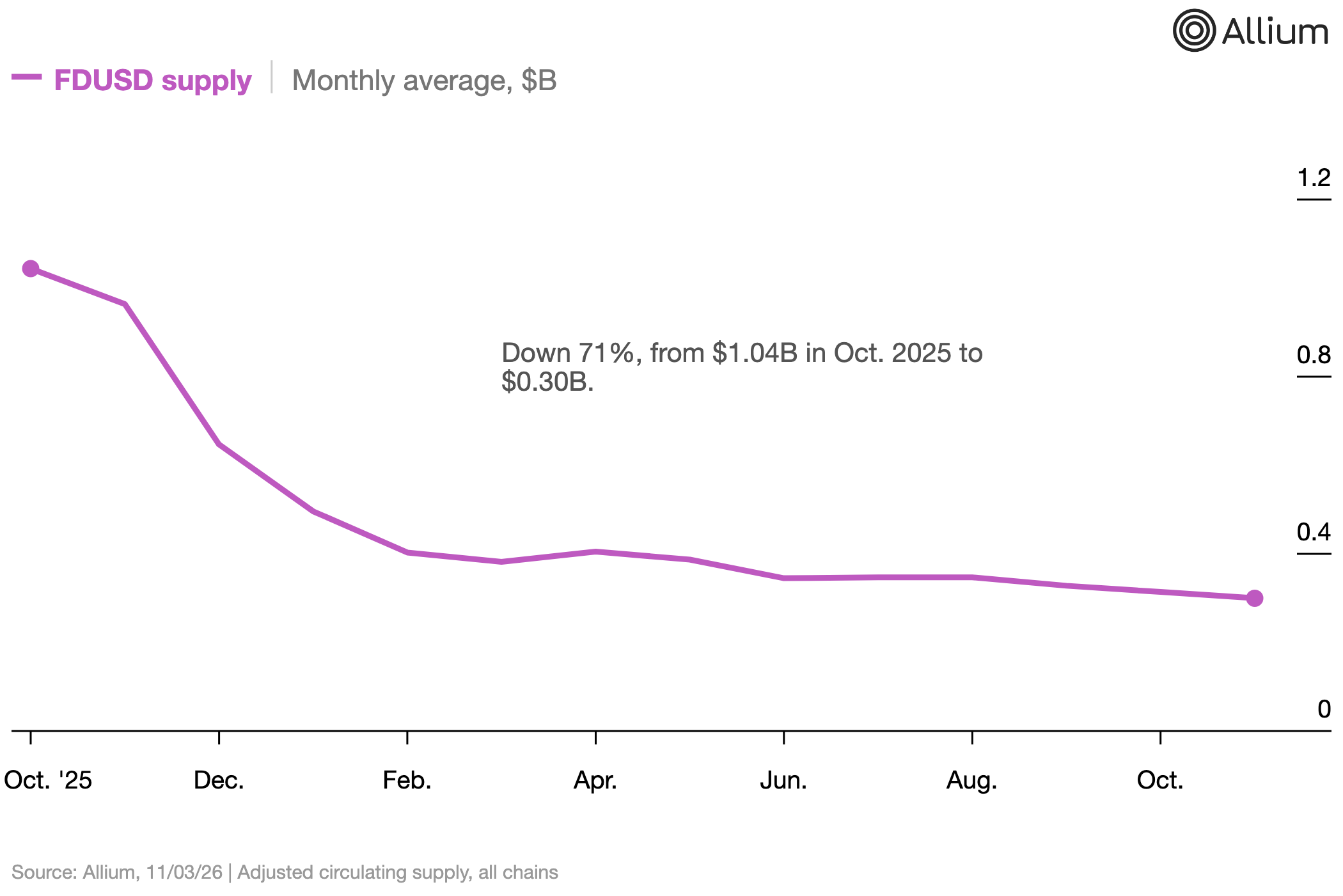
The decline is front-loaded: supply fell from $1.04B to $0.40B between October 2025 and February 2026, then held between roughly $0.30B and $0.41B for the rest of the year. A falling supply means net redemptions, tokens being returned to the issuer for dollars faster than new ones are minted. The supply data shows that it happened; it does not by itself show why.
| Chain | Adjusted supply | Organic volume, 30 days | Organic transfers |
|---|---|---|---|
| Ethereum | $190.1M | $36.4M | 126 |
| BSC | $58.8M | $3.4M | 26,741 |
| Sui | $43.5M | not measured | |
| Solana | $8.5M | under $0.1M | 72 |
Allium data. Supply as of November 3, 2026; adjusted (organic) volume Oct 4 to Nov 2, 2026.
The usage pattern is the telling part. On Ethereum, $36.4M moved in just 126 organic transfers, an average of roughly $290,000 each: the shape of treasury and exchange movements. On BSC, the transfers are many and small, about $127 on average, but they total only $3.4M. Neither looks like a stablecoin in wide use for payments, which fits FDUSD's role as an exchange trading asset whose main activity happens on exchange books rather than onchain.
How the FDUSD figures are measured
Allium's adjusted circulating supply starts from total supply and removes issuer reserves, bridge escrows, protocol collateral, savings vaults and frozen addresses, so it measures the supply that is actually free-floating. Organic volume uses Allium's adjusted volume method, which filters out non-organic transfers. The gap matters: FDUSD's raw transfer volume on BSC was about $200M over the same 30 days, against $3.4M organic. Each figure resolves to the same fields per deployment across 150+ chains in Allium's stablecoin datasets. For what issuers in general are expected to disclose, see stablecoin issuer.
Frequently asked questions
Who issues FDUSD?
FDUSD is issued by First Digital, a Hong Kong-based trust company. It redeems tokens 1:1 for onboarded customers on its published terms.
How much FDUSD exists?
Allium's data shows about $0.30B of adjusted supply on November 3, 2026, down from a monthly average of $1.04B in October 2025.
Which chains is FDUSD on?
Mainly Ethereum ($190.1M), BSC ($58.8M), Sui ($43.5M) and Solana ($8.5M), according to Allium on November 3, 2026.
Why did FDUSD supply fall?
Supply falls when more tokens are redeemed than minted. Allium's data shows the net redemptions; the reasons behind them are not visible onchain.
See the data behind this post. Browse the stablecoin tables, or read How to Monitor Stablecoin Balances Across Chains for how the records are put together.
Building something that needs this data? Talk to the team.
Allium provides onchain data infrastructure. Companies named in this article may be Allium customers, prospects or commercial counterparties. The authors and other Allium personnel may hold positions in the assets discussed. This article is informational only and is not investment, legal or tax advice. Data and information last reviewed: November 4, 2026.