What Is Sui? How the Move Blockchain Works
Sui is a layer 1 blockchain built by Mysten Labs that runs Move smart contracts and stores data as objects, which lets unrelated transactions execute in parallel.

Sui is a layer 1 blockchain developed by Mysten Labs that runs smart contracts written in Move and stores data as individual objects rather than account balances, which lets it execute unrelated transactions in parallel. Its mainnet launched in 2023, and its native token, SUI, pays transaction fees and secures the network through staking.
Key takeaways
- Sui was built by Mysten Labs, founded by engineers who worked on Meta's Diem project.
- Assets on Sui are objects with owners. Transactions that only touch objects owned by one party can skip full consensus ordering, which is the source of its speed.
- Move is designed so a contract cannot copy or silently destroy an asset, which rules out some classes of bugs common elsewhere.
- Allium tracks $448.4M of stablecoins on Sui across 7 tokens, 69.1% of it USDC (Allium data, November 3, 2026).
Objects instead of accounts
Most blockchains store state as accounts with balances, and every transaction is ordered against all the others. Sui stores state as objects. A coin, an NFT or a trading position is an object with an ID and an owner, and a transaction declares which objects it touches.
- Owned objects belong to one address. A transfer of an owned coin does not conflict with anything else, so it can be processed without waiting in a global queue.
- Shared objects, such as a trading pool many users interact with, can be touched by anyone. Transactions on them go through consensus so their order is agreed.
Two unrelated payments can therefore execute at the same time, while a busy shared pool is ordered properly. Validators stake SUI to take part in consensus, and users pay fees in SUI.
| Sui | Ethereum | Solana | |
|---|---|---|---|
| Smart contract language | Move (Sui variant) | Solidity, Vyper | Rust |
| How state is stored | Objects with owners | Accounts with balances | Accounts, declared per transaction |
| Parallel execution | Yes, for transactions on separate objects | No, sequential | Yes, for transactions on separate accounts |
| Gas token | SUI | ETH | SOL |
How much money is on Sui, and what kind
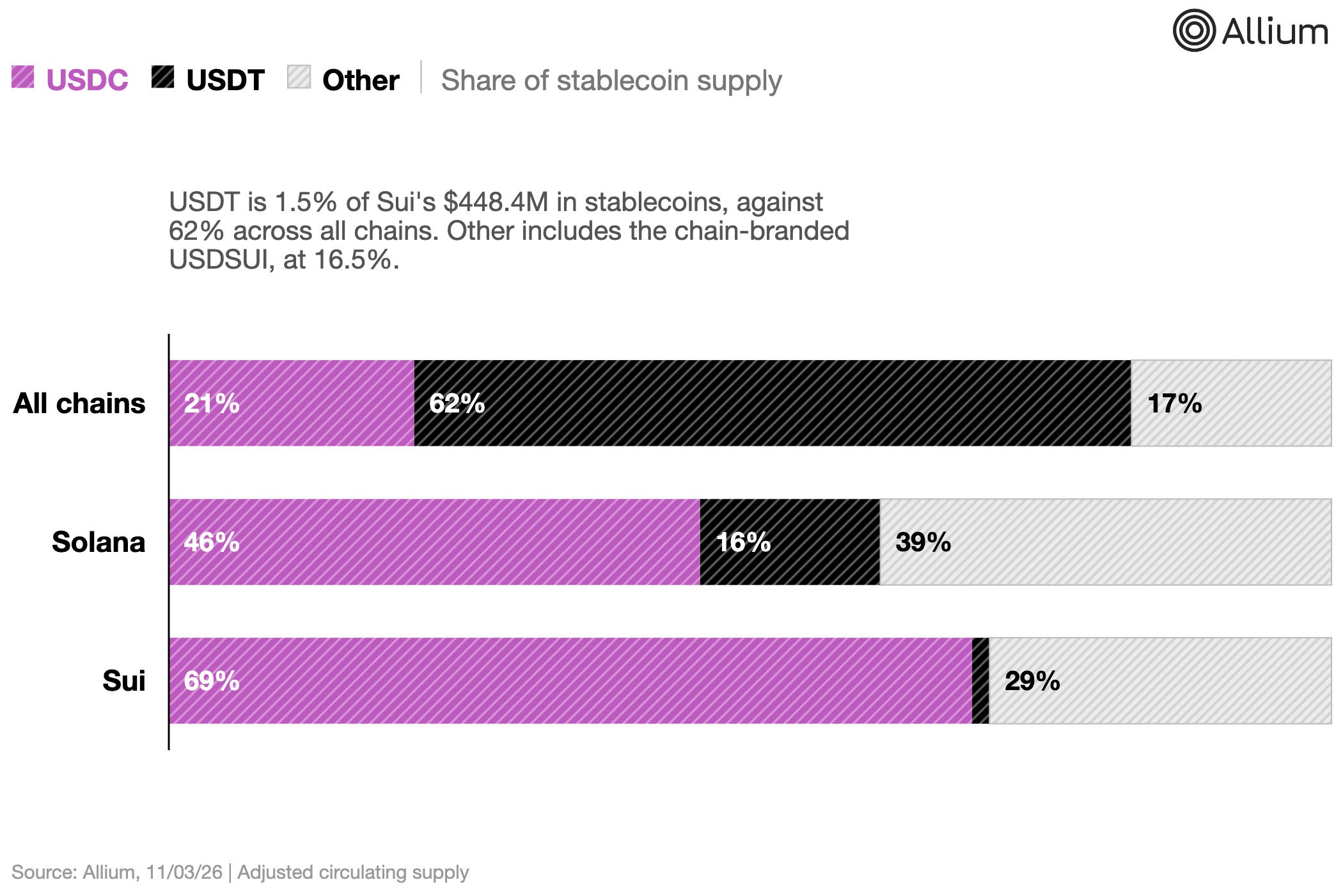
Allium tracks $448.4M of stablecoins on Sui across 7 tokens. For scale, Base holds $5.35B and Solana $14.63B. The composition is the more telling part:
| Stablecoin on Sui | Adjusted supply | Share of Sui total |
|---|---|---|
| USDC | $309.8M | 69.1% |
| USDSUI | $74.1M | 16.5% |
| FDUSD | $43.5M | 9.7% |
| suiUSDe | $12.4M | 2.8% |
| USDT | $6.8M | 1.5% |
| Two smaller tokens | $1.8M | 0.4% |
| Total | $448.4M |
Allium data, November 3, 2026, adjusted circulating supply.
Across all chains, USDT is about 62% of stablecoin supply. On Sui it is 1.5%. The second-largest dollar on the chain is USDSUI, a token branded for Sui itself. On newer chains, the dollar mix depends heavily on which issuers deploy natively, and a chain-branded stablecoin is one way a network secures dollar liquidity it does not have to wait for a third-party issuer to provide.
Why Sui data needs translating before it can be compared
Because Sui records objects rather than account balances, a USDC transfer on Sui does not look like a USDC transfer on Ethereum. Comparing supply or activity across chains means resolving each record to the same fields: asset, issuer, sender, recipient, amount, USD value and whether the token is native or bridged. Allium normalizes Sui alongside 150+ other chains into those fields, which is what lets the Sui figures sit next to Ethereum and Solana in one query. Allium's adjusted supply also removes issuer reserves, bridge escrows, protocol collateral, savings vaults and frozen addresses, so the $448.4M is free-floating supply.
Frequently asked questions
Who created Sui?
Sui was developed by Mysten Labs, a company founded by engineers who previously worked on Meta's Diem blockchain project. Its mainnet launched in 2023.
What is the SUI token used for?
SUI pays transaction fees on the network and is staked by validators and delegators to secure consensus.
Is Sui an Ethereum layer 2?
No. Sui is an independent layer 1 blockchain with its own validators and consensus. It does not settle to Ethereum.
How much stablecoin supply is on Sui?
Allium tracks $448.4M across 7 stablecoins on Sui on November 3, 2026, with USDC at $309.8M, or 69.1%.
What is Move?
Move is a smart contract language originally built for Diem. It treats assets as resources that cannot be copied or accidentally destroyed, and Sui uses its own variant.
Compare chains on the same data. Browse chain-level coverage across 150+ chains, or read What Is Onchain Data Normalization? for how the records are put together.
Building something that needs this data? Talk to the team.
Allium provides onchain data infrastructure. Companies named in this article may be Allium customers, prospects or commercial counterparties. The authors and other Allium personnel may hold positions in the assets discussed. This article is informational only and is not investment, legal or tax advice. Data and information last reviewed: November 4, 2026.