From Prompts to Reproducible Financial Workflows With MCP

Key takeaways:
- Financial institutions can’t use natural language prompts alone to get reliable outputs
- Prompts are not reproducible or auditable on their own
- MCP acts as the “USB-C” for AI
- Institutions need to use MCP with a structured data layer to get trusted outputs
Model Context Protocol is an open standard that allows AI systems to securely connect to external APIs, databases, and workflows through an interface. MCP enables both humans and AI agents to execute structured, repeatable actions across systems.
Most financial institutions are still using AI like a search engine: asking ChatGPT or Claude slightly different questions until they get an answer that “looks right.”
But if one analyst asks a model a question, and another analyst asks the model the same question the next day, is there any guarantee that the answers will be the same? Will the model pull the same data, call the same tool, and generate the same result?
The problem is that prompts are not operational systems. Institutions cannot rely on workflows that produce different outputs depending on phrasing, model versions, or hidden retrieval behavior. Financial infrastructure requires reproducibility, auditability, and governed data access.
This is where Model Context Protocol (MCP) comes in. MCP changes AI from a prompting interface that lends itself to conversation to a workflow interface that lends itself to execution. Instead of analysts manually stitching together prompts and SQL queries, MCP is what allows natural language to trigger structured, repeatable processes.
This shift has started gaining attention well beyond infrastructure teams. Allium’s MCP workflow demonstration — like this widely shared breakdown of natural language triggering repeatable operational workflows — highlights how quickly the industry is moving away from ad-hoc prompting.
Why Prompt-Based Financial Workflows Break Down
Prompt-based workflows may seem like the natural, easy choice when building with AI — it’s like having a conversation with a real analyst. However, prompts on their own introduce failure models that simply aren’t compatible with financial systems. Breakdowns occur specifically because of how prompts fundamentally operate.
Prompts Are Difficult to Reproduce
Prompts are not stable execution environments: they’re just inputs into a probabilistic system.
Even small changes in phrasing or the AI model version can give you materially different results. A reused prompt may seem like it could give the same answer every time, but the underlying conditions shaping the response itself (data freshness, reasoning, tool retrieval) are rarely preserved.
For financial institutions, any variety will quickly compound into larger errors. Portfolio calculations or risk estimates can’t depend on an interaction that cannot be re-run. What may look like a workflow in practice is usually just a one-time interaction.
Institutional Systems Need Deterministic Outputs
Financial institutions require outputs to be repeatable. The same inputs need to produce the exact same outputs at any point in time: this kind of consistency underpins reconciliation, reporting, compliance, and audit processes.
When you use prompts, you’re introducing non-deterministic behavior into a financial environment that requires determinism. Prompts introduce probabilistic behavior into systems that require deterministic outputs.
Auditability Disappears When Logic Lives in Chat History
Prompt-based workflows obscure execution logic. Institutions cannot reliably see which tools were called, what intermediate steps were taken, or whether the same workflow would produce the same output tomorrow.
The logic of data outputs from prompts is too scattered and unreliable to be useful to auditors or internal reviewers. When specific questions like “what sequence of steps led to this data?” need to be answered, chat history is not going to have a defendable answer. Chat history is not an auditable system.
Natural Language Alone Is Not a System of Record
Even though natural language prompts may get you the answers you need, they’re not actually sources of truth on their own. A real system of record requires canonical data definitions, consistent schemas, point-in-time correctness, and a clear path from input to output. Prompt-based workflows can initiate system of record analysis, but they can’t anchor it.
It’s the core limitation: natural language can describe a workflow, but without structured data underneath, it cannot function as a system of record. This is the gap MCP and structured data infrastructure are designed to solve.
MCP Changes AI From Conversation Into Infrastructure
MCP turns AI from a conversational interface into an execution layer. Instead of manually stitching together prompts, SQL queries, and dashboards, institutions can use natural language to trigger structured, repeatable workflows across governed systems. An easy way to think about MCP is as a “USB-C port for AI” — it’s a tool that lets an LLM connect directly to the data sources that it needs to perform tasks. APIs standardized how software systems communicate. MCP standardizes how AI systems interact with tools, workflows, and data infrastructure.
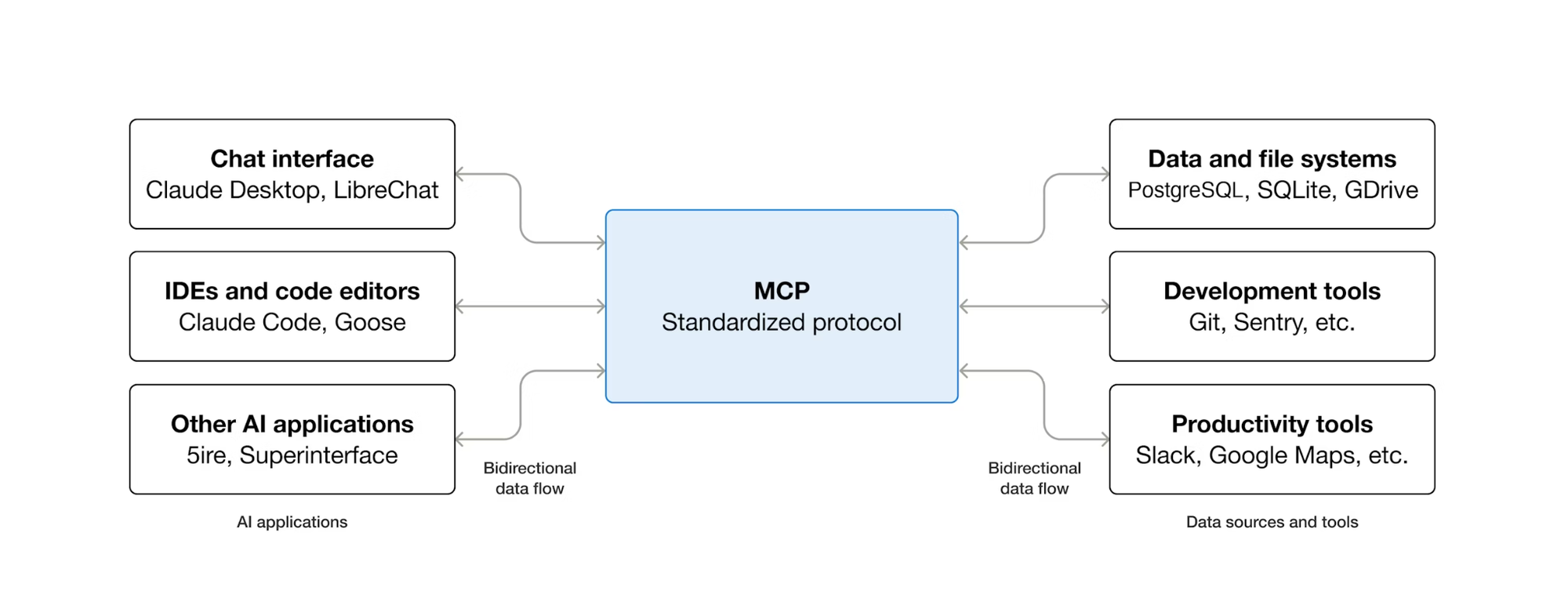
Source: Model Context Protocol
With MCP, you can still utilize natural language prompts, but they’re being routed through the real databases and workflows that allow for repeatable, deterministic outputs.
MCP Standardizes How AI Connects to Systems
With MCP, fragmentation is replaced with a shared contract.
LLMs have a standardized layer to interact with the tools and data services required, which creates predictable behavior across ecosystems. The model is no longer improvising on how to access the system, but operating within a defined interface.
MCP Separates Reasoning From Execution
Prompt-based systems combine decision-making and execution into a single step.
The model interprets the task, decides what to do, and performs it all within one interaction. The logic is implicit, and the execution path is not preserved.
MCP separates reasoning from execution:
- The model decides what should happen
- The system executes how it happens
That separation makes workflows reproducible, traceable, and governable.
Why Reproducibility Is Becoming the Core AI Requirement in Finance
Reproducibility is a requirement for financial institutions, as they operate with a high level of transparency and compliance requirements. AI introduces flexibility in previous inflexible financial workflows, but that flexibility becomes risk if the AI system isn’t producing consistent and auditable outputs.
Compliance Requires Explainable Decision Paths
Compliance systems are designed around reproducibility. If a decision cannot be rerun and explained, it cannot be trusted operationally.
Financial institutions need explainable systems where the same query can be rerun over and over, by risk teams, compliance teams, auditors, etc. and get the same output every single time with a clear reasoning process
AI Cannot Become Operational Infrastructure Without Governance
Most AI deployments in finance fail at the moment outputs need to be trusted operationally. Experimental AI systems optimize for flexibility. Financial systems optimize for reliability.
For AI to move beyond experimentation, it needs to operate within governed systems. This is the constraint that determines whether or not AI becomes a tool or becomes part of the system itself.
MCP + Structured Data Is What Makes Financial AI Operational
MCP turns natural language into executable workflows, but it’s not the execution that makes them reliable. If the underlying data is inconsistent, then the workflow will still produce outputs that can’t be reproduced or audited. System-of-record-level data is the missing layer in most AI deployments in finance.
MCP Orchestrates Workflows — The Data Layer Makes Them Reliable
MCP defines how AI systems interact with tools and data, but it doesn’t define what the data means.
For financial workflows to be operational, the data layer needs to provide certain things:
- Consistent definitions across assets, chains, and systems
- Normalized schemas that remove ambiguity
- Point-in-time accuracy that allows outputs to be recomputed
Without that foundation, even well-structured workflows produce results that can’t be trusted in audits, risk systems, or production environments.
This is where system-of-record infrastructure becomes critical. Platforms like Allium normalize raw blockchain data into consistent, point-in-time correct schemas that can be recomputed, verified, and audited over time.
Through Allium’s MCP server, AI agents can execute SQL queries, run saved workflows, and interact with structured blockchain datasets through standardized tool calls instead of ad-hoc prompt retrieval. Allium ensures that MCP workflows produce outputs that are consistent and defensible.
FAQs About MCP and Financial Workflows
What is MCP in AI?
Model Context Protocol (MCP) is a standard that allows AI systems to connect to external tools, data sources, and workflows through a consistent interface. MCP enables models to move beyond answering questions and instead execute structured, repeatable actions across real systems.
How is MCP different from APIs?
APIs define how one system requests data or services from another. MCP defines how AI models interact with many tools and data sources in a standardized way.
Instead of integrating APIs one by one, MCP provides a unified layer that allows models to discover, call, and coordinate multiple tools within a single workflow.
Can MCP workflows be audited?
MCP makes workflows more auditable by structuring how actions are executed across systems.
However, auditability depends on both the workflow and the underlying data. To fully audit an MCP workflow, each step must be traceable and the data must be consistent and recomputable.
Does MCP replace existing financial systems?
No, MCP does not replace existing financial systems. Instead, MCP sits on top of existing systems and orchestrates how AI interacts with them. It connects models to databases, APIs, and workflows, allowing institutions to use their existing infrastructure in a more structured and automated way.
Why do AI agents need structured data?
AI agents depend on structured data to operate reliably.
Unstructured or inconsistent data leads to ambiguous outputs and non-repeatable behavior. Structured data provides clear definitions, consistent schemas, and point-in-time accuracy, which are required for reproducible workflows.
What does MCP have to do with systems of record?
MCP enables workflows, but systems of record make those workflows reliable.
A system of record provides consistent, normalized, and recomputable data. MCP allows AI to act on that data in a structured way. Together, they enable workflows that are reproducible, auditable, and suitable for financial infrastructure.
From Prompting to Financial Operations
Most teams start with prompts, and that’s fine for exploration. But this system breaks the moment the output needs to be used again next week.
MCP makes it possible to turn a question into a workflow, which is exactly what financial institutions need to make AI use possible within their compliance and risk guidelines. But there’s one more catch: MCP and AI only works if the workflow runs on data that’s consistent and can be recomputed.
In the future, the useful financial AI systems won’t be the ones that only sound right, but the ones that you can run again and again and get the same result, with a clear path back to the data. That is the moment AI stops being an assistant and becomes infrastructure.
Interested in learning more about Allium’s onchain data infrastructure? Speak to someone on the team.