Prediction market data

Trades, prices, order books and open interest for Polymarket, Kalshi and Hyperliquid, normalized into one schema. Query it in SQL or pipe it into your own warehouse.


Request access
Read the docs
Awaken
Stripe
Visa
Electric Capital
Standard Chartered
Magic Eden
Monetary Authority of Singapore
Taxbit
Boston Consulting Group
Jito
Slash
Coinbase
Metamask
a16z crypto
Phantom
Moonpay
Uniswap
Grayscale
Awaken
Stripe
Visa
Electric Capital
Standard Chartered
Magic Eden
Monetary Authority of Singapore
Taxbit
Boston Consulting Group
Jito
Slash
Coinbase
Metamask
a16z crypto
Phantom
Moonpay
Uniswap
Grayscale
Awaken
Stripe
Visa
Electric Capital
Standard Chartered
Magic Eden
Monetary Authority of Singapore
Taxbit
Boston Consulting Group
Jito
Slash
Coinbase
Metamask
a16z crypto
Phantom
Moonpay
Uniswap
Grayscale
Awaken
Stripe
Visa
Electric Capital
Standard Chartered
Magic Eden
Monetary Authority of Singapore
Taxbit
Boston Consulting Group
Jito
Slash
Coinbase
Metamask
a16z crypto
Phantom
Moonpay
Uniswap
Grayscale
Awaken
Stripe
Visa
Electric Capital
Standard Chartered
Magic Eden
Monetary Authority of Singapore
Taxbit
Boston Consulting Group
Jito
Slash
Coinbase
Metamask
a16z crypto
Phantom
Moonpay
Uniswap
Grayscale

The problem we solve: every venue keeps its data differently

Polymarket settles onchain across three contract versions. Kalshi publishes through a centralized API with its own fee schedule. Newer venues route orders through both. Building a clean history means maintaining a pipeline per venue before you can ask a single question of it.

Three contract versions on Polymarket

Trades from v1, v2 and v3 contracts, including combos, each decode differently before they line up.

A separate fee model on Kalshi

Fees vary by series and change over time, so the price you see and the price paid drift apart.

Flow that crosses venues

Jupiter and DFlow route orders to Kalshi and Polymarket, so one market trades in more than one place.

Prediction market data for every major venue

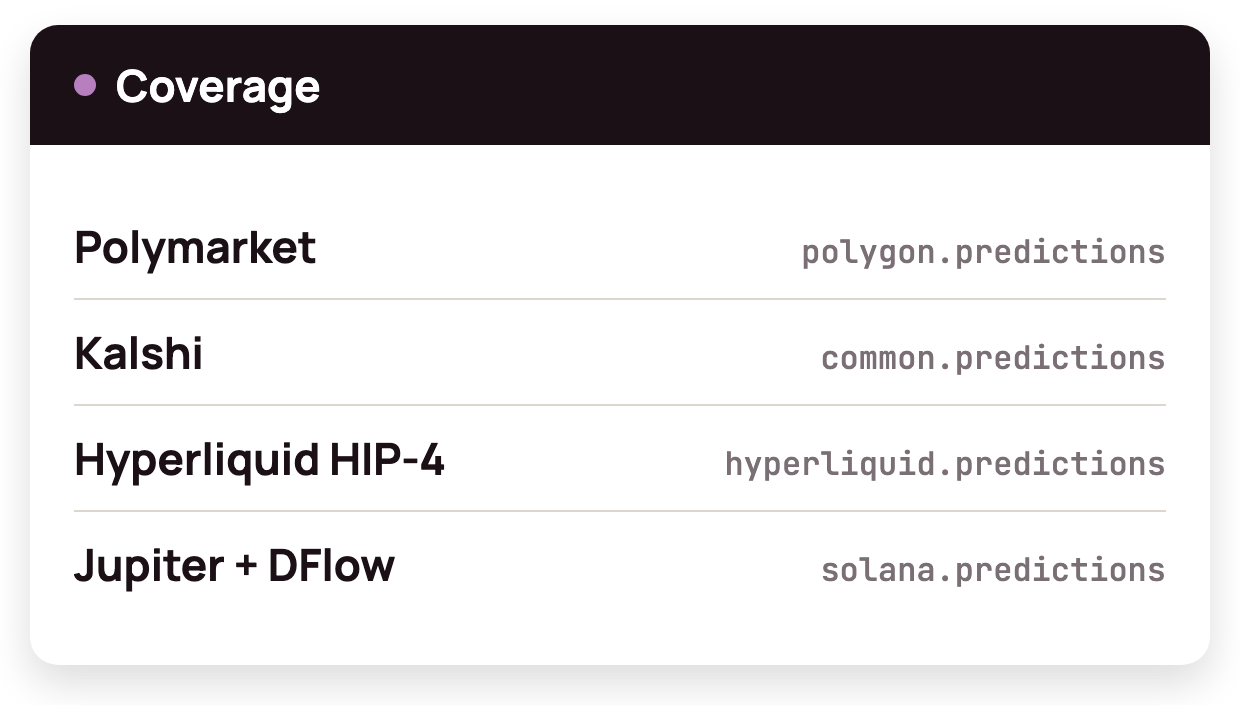
Every major venue, one schema

Polymarket trades across v1, v2 and v3 contracts, including combos

Kalshi markets, events, series and fee schedule changes

Hyperliquid HIP-4 markets, plus Kalshi and Polymarket flow routed through Jupiter and DFlow

Polymarket, Kalshi and Hyperliquid in the same tables, so one query covers every venue.

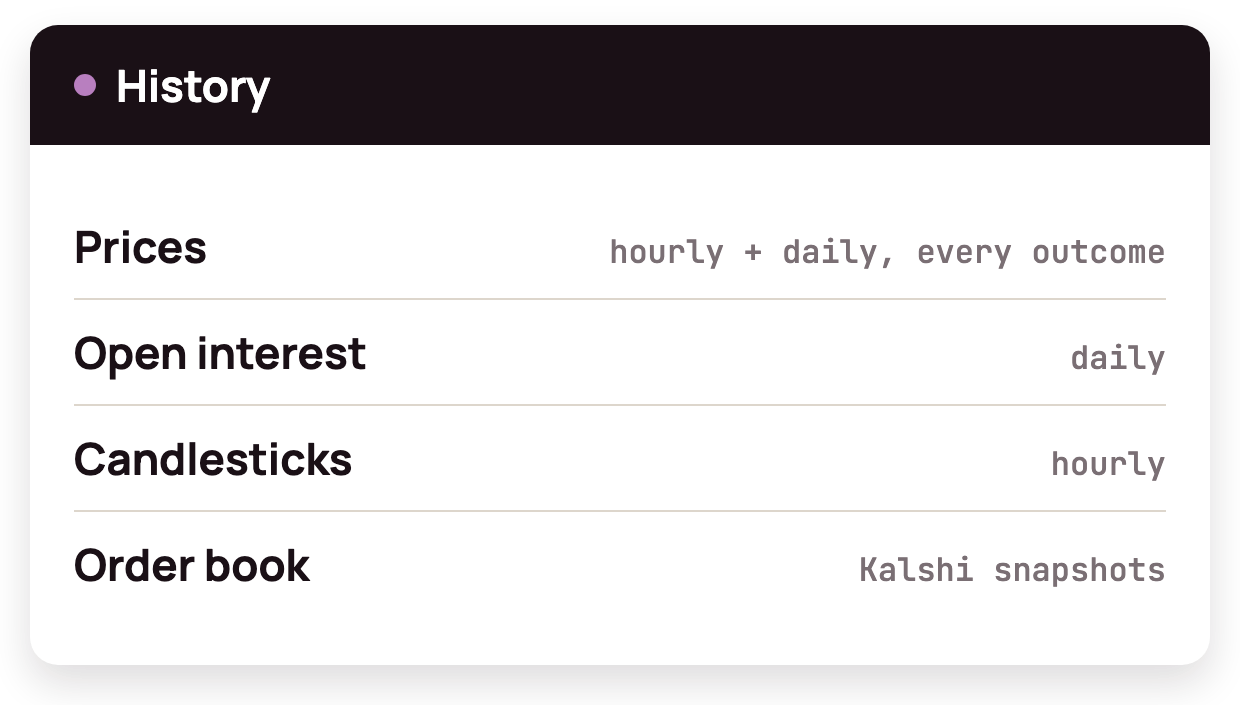
Prices and liquidity over time

Hourly and daily prices for every outcome token

Daily open interest and hourly candlesticks

Kalshi order book snapshots for depth and spread analysis

Price, open interest and depth history for backtests and research.

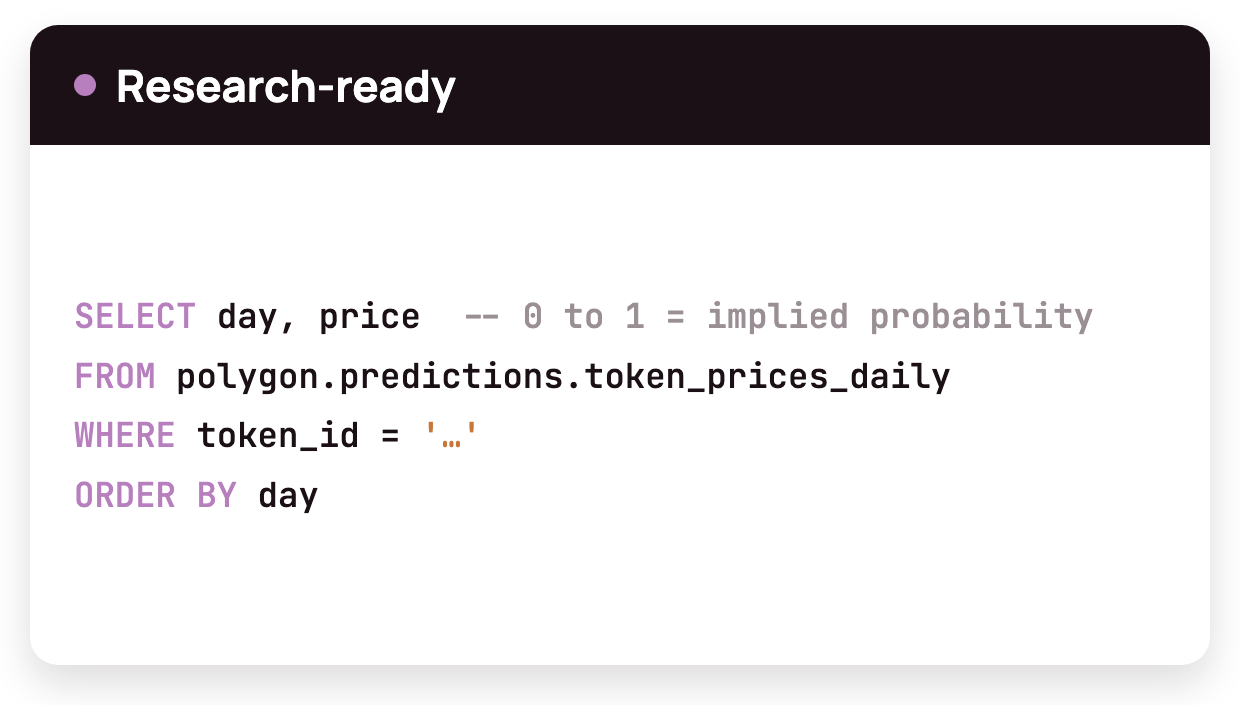
Built for analysis, not reconstruction

Prices on a 0 to 1 scale, read directly as implied probability

Fee-adjusted Kalshi trades, with the fee formula documented

Wallet-level Polymarket positions and actions

The same tables power Allium's own prediction markets research.

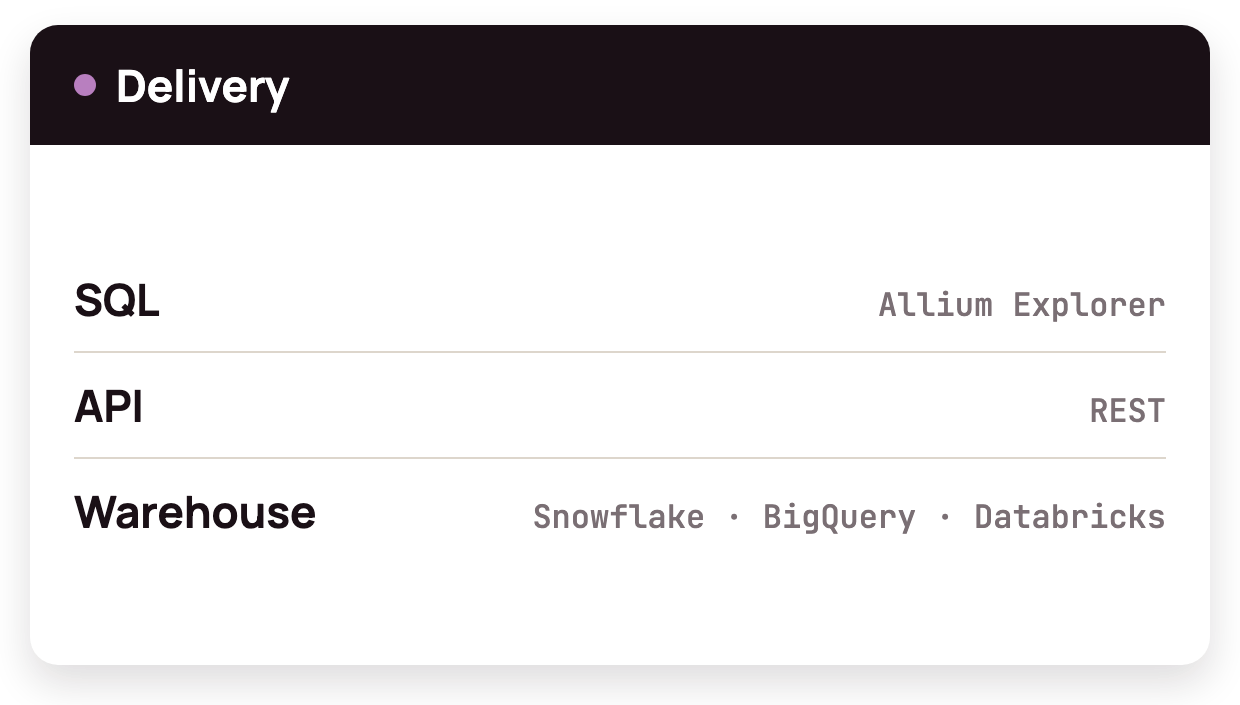
Where your team already works

SQL in the Allium Explorer

REST API for your applications and models

Delivered into Snowflake, BigQuery or Databricks

Same data in SQL, by API or in your own warehouse.

Prediction market history you can query, not rebuild
Without Allium
One pipeline per venue, each in its own format
Polymarket, Kalshi and Hyperliquid each need their own ingestion, decoding and fee logic.
Past prices and positions rebuilt by hand
Backfilling from raw events is slow, and every rebuild can give a different answer.
Data stuck in scripts and notebooks
Analysts maintain scrapers before anything reaches your own models.
Every major venue in one schema.
Polymarket, Kalshi and Hyperliquid HIP-4, plus flow routed through Jupiter and DFlow, normalized the same way.
Prices, open interest and order books over time.
Hourly and daily prices for every outcome token, daily open interest, and Kalshi order book snapshots.
Data in SQL, by API or in your warehouse.
Query it in the Allium Explorer, call the API, or receive it in Snowflake, BigQuery or Databricks.

Research built on this data

Get new Allium research in your inbox

July 30, 2026
Polymarket and Kalshi now predict future GPU rental prices
GPU rental prices now trade months ahead across Kalshi and Polymarket, with both markets settling against Ornn, the index that tracks live GPU rental prices. This report examines what traders expect across Nvidia's main AI chips, how the two venues work, and whether their prices provide useful signals for future compute costs.
Read
July 30, 2026
Onchain: The New Alternative Alpha
Perpetual futures and prediction markets now trade real money around the events that move markets, from the SpaceX IPO to the US-Iran oil shock to Fed decisions. This deck collects ten case studies on where that signal shows up first onchain and how investors can read it, all built on Allium data.
Read
June 25, 2026
Nvidia holds 74% of the odds on a $600B lead
We read eight Polymarket markets, one per candidate, to see which company onchain traders back to finish 2026 as the world's most valuable. Nvidia leads at 74%, holding about seven times its nearest rival's odds on a real market-cap lead of just $600B. This spring its odds even rose while its stock fell 13%.
Read
June 15, 2026
Prediction markets price the Fed almost exactly like Wall Street
The Fed meets Wednesday. Two prediction markets, Kalshi and Polymarket, price the decision alongside the futures the professionals use.
Read
Explore the Full Research Library

FAQ

Which prediction markets does Allium cover?

Polymarket, Kalshi and Hyperliquid HIP-4, plus prediction-market trades routed through Jupiter and DFlow on Solana.

How is Kalshi data different from Polymarket data?

Kalshi is a centralized, CFTC-regulated exchange, so its data comes from the exchange. Polymarket settles onchain, so every trade and position is public. Allium normalizes both into the same shape.

Can I get Polymarket historical data without running my own indexer?

Yes. Trades, prices and positions are already decoded and queryable in SQL.

How do I get the data?

Query it in SQL in the Allium Explorer, call it through the API, or have it delivered into Snowflake, BigQuery or Databricks next to your own models.

Start with the data you need

Request access
Read the docs
Decorative